Driving License Process in Texas: Step‑by‑Step Guide for 2026
Getting a Texas driver's license doesn't have to feel like navigating a maze blindfolded. The driving license process in Texas is straightforward once you know exactly what's expected. This guide breaks every step down so you can walk into your DPS office prepared and walk out with a license.
Key Takeaways
All new drivers must apply in person at a Texas driver license office and pass three tests - a vision test, a written knowledge test, and a road test - to earn a Texas driver's license in 2026.
Drivers under 25 must complete a driver education course and the Impact Texas Drivers video program before taking the road test.
You must bring specific documents proving identity, Texas residency, your social security number, and lawful presence, plus a completion certificate if you finished driver education.
Adults aged 18–24 must complete a 6-hour driver education course, while teens aged 15–17 must complete a state-approved driver education program - but both groups must pass the same driving test.
The fee for a Texas driver's license is $33 for a standard Class C license (ages 18–84), and many renewals and replacements can be handled online if you're eligible.
Overview of the Texas Driver License Process
Obtaining a driver's license in Texas involves several steps: education, documentation, testing, and in-person visits. You'll gather your documents, complete any required driver education course, take your three tests at a DPS office, and then wait for your plastic card in the mail.
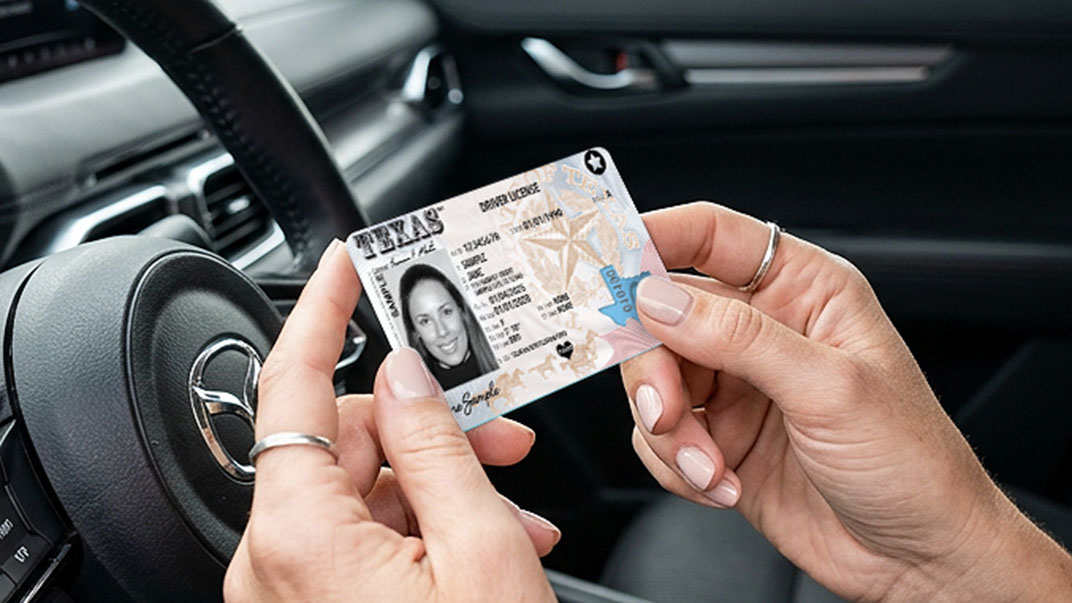
A Texas driver license lets you legally operate a passenger vehicle (Class C). A Texas ID card is for identification only, and a learner license (permit) is for supervised practice. This guide focuses on the standard Class C license.
The process has three main phases: (1) eligibility and preparation, (2) application and testing at a driver license office, and (3) receiving and maintaining your license through renewals, replacements, or upgrades.
The Department of Public Safety (DPS) manages licensing. Some road tests can be taken through third-party test providers approved by DPS.
Timelines and forms can change. Always confirm details on the official Texas DPS website before scheduling your appointment.
Who Is Eligible for a Texas Driver's License?
Texas has age, residency, and lawful presence rules you must meet before you can submit a driver license application. Requirements for getting a Texas driver's license depend on age.
Age brackets: Teens 15–17 start with a learner permit and provisional license. Texas adult drivers 18–24 need a mandatory adult driver education course. Adults 25+ can skip driver education, though it's highly recommended.
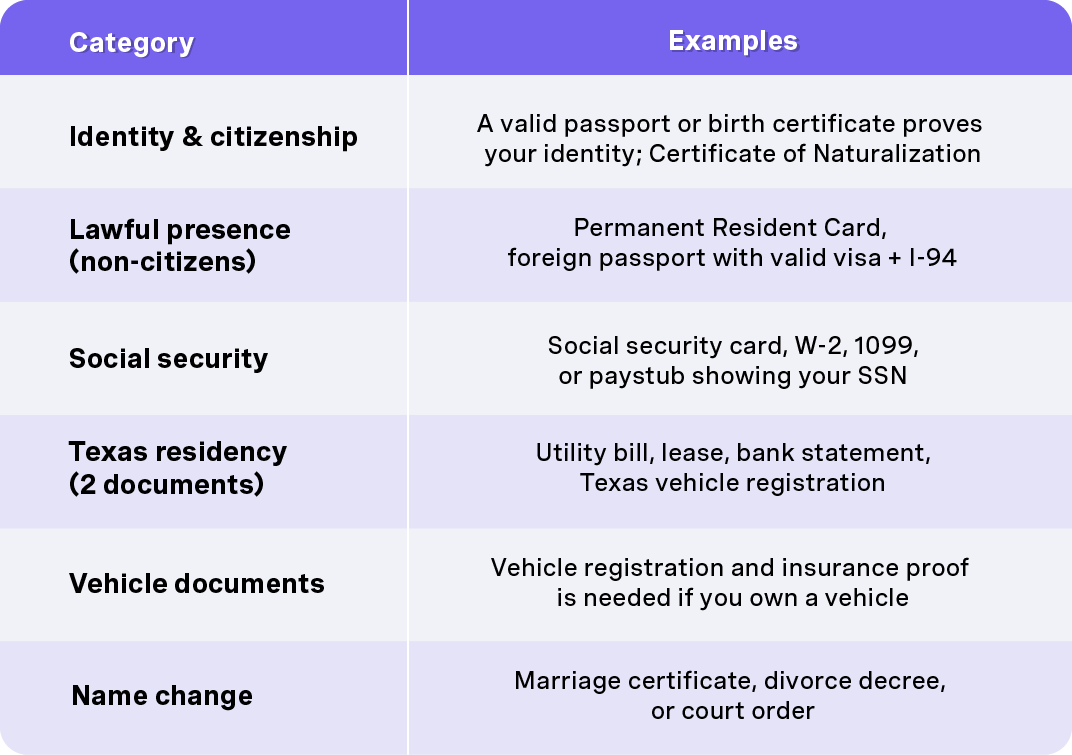
Residency: You must live in Texas and show proof of Texas residency, like utility bills, a lease, bank statements, or Texas vehicle registration dated within 90 days.
Lawful presence and citizenship: Proof of U.S. citizenship or lawful presence is required. Acceptable documents include a U.S. passport, U.S. birth certificate, Certificate of Naturalization, Permanent Resident Card, or valid immigration documents with I-94. As of January 2026, TDLR enforces updated lawful presence documentation rules.
Social security: You must provide your social security number when applying, using a social security card, W-2, or similar official document. If you're not eligible for a social security number, DPS allows an affidavit with supporting evidence.
Out-of-state drivers: If moving to Texas with a valid out-of-state license, you must transfer within 90 days. The process may differ and might not require all testing if your existing license is current.
Documents and Forms You Must Bring
Show up without the right documents and you're making a second trip. Arrive at the driver license office with complete, unexpired proof for every category.
All applicants must complete a driver license application (form DL-14A or current equivalent) either online before the visit or on paper at the office. Every detail must match your supporting documents.
Driver Education and Required Courses
Texas uses driver education and online safety programs to prepare new drivers for the driving test and reduce risks related to distracted driving, especially among young and inexperienced drivers.
Who needs it: All applicants under 25 must complete the Impact Texas Drivers program and a state-approved driver education course. Adults 25+ may skip it but enrolling helps build knowledge of road signs and safe driving practices.
Teen vs. adult course: Teens get 24 hours of classroom instruction plus behind the wheel practice with a certified instructor, including night driving hours. Texas requires a 6-hour adult driver's education course for ages 18–24, available online or in person.
Completion certificate: Finishing your course yields a completion certificate (DE-964 or equivalent). This certificate is your proof at DPS and can sometimes waive the written knowledge test.
Impact Texas Drivers: The Impact Texas Teen Drivers (ITTD) program covers teens, while Impact Texas Adult Drivers (ITAD) serves ages 18–24. The Impact Texas Drivers video course is required before taking driving skills tests in Texas. The Impact Texas Drivers certificate is valid for 90 days - bring it to your scheduled road test.
Step‑by‑Step: Application, Driving Tests, and Getting Your License
Here's the sequence from submitting your driver license application to holding your Texas driver's license card. Each step builds on the last, so complete them in order.
Fill out the application: Choose the correct license type (Class C for most drivers), disclose any medical conditions, and sign. Some applicants can start the application online to save time at the office.
Pay the fee: The application fee for a Texas driver's license is $33 for standard Class C (ages 18–84). License fees vary based on driver type and age. Renewal fees differ depending on the method of renewal.
Vision test: The vision test checks visual acuity at the DPS office. Texas requires passing a vision test for a driver's license. If you need glasses or corrective lenses to pass, a restriction goes on your license.
Written knowledge test: The written exam tests knowledge of Texas driving laws, texas traffic laws, and road signs. It's multiple-choice, based on the Texas Driver Handbook, and available in English and Spanish. Your driver education course may waive this test. Online practice tests are a smart way to prepare.
Road test: A practical driving skills test must be passed to receive a Texas driver's license. Schedule your driving skills test through DPS or a third-party skills testing provider. Bring a properly registered and insured car that passes safety inspection. The examiner evaluates turns, lane changes, parking, obeying signs, and safe speed. You must drive safely throughout.
After you pass: Applicants receive a temporary license at the DPS office after passing necessary tests. Your permanent plastic driver's license will be mailed within 2 to 3 weeks. If you fail, there may be waiting periods before a retest.
Renewals and replacements: Many drivers can renew online or by mail if eligible. Lost or stolen licenses cost about $11 to replace. Removing restrictions or upgrading may require an additional driving skills test.
FAQ: Texas Driving License Process
These questions cover practical details about the process that come up constantly - timelines, appointments, and edge cases.
How long does it take to get a Texas driver's license after I pass my tests?
You receive a temporary paper license immediately at the DPS office. The plastic Texas driver's license typically arrives by mail within about 2–3 weeks, though mailing times vary by location and season. If it hasn't arrived within the timeframe on your receipt, check the status online through DPS or contact your driver license office.
Do I need an appointment for the driving test or can I just walk in?
Many Texas driver license offices require or strongly recommend an appointment for the road test and application visit, especially in larger cities where walk-in slots fill quickly. You can schedule driving tests online through the DPS appointment system or with approved third-party providers, which may offer more flexible dates.
Can I use a rental car for my Texas road test?
The vehicle must be properly insured, currently registered, and pass a basic safety check. Some DPS offices and third-party testers may not accept rental vehicles unless you are listed as an authorized driver on the rental agreement. Call your specific office ahead of time to confirm, and bring the rental contract plus proof of vehicle insurance if allowed.
What if I don't have a Social Security number - can I still get a Texas driver license?
Texas generally requires applicants to provide a social security number if they are eligible for one, using a social security card or official tax form. Certain non-citizens who are not eligible may complete an affidavit of non-eligibility with supporting lawful presence documents. Verify current rules directly on the DPS website, as requirements around public safety documentation evolve.
Does a Texas driver's license automatically let me drive in other states?
A valid Texas driver's license is generally honored by other U.S. states, allowing you to drive while traveling as long as you follow the traffic laws of that state. If you move permanently to another state, you'll need to transfer your Texas license within that state's required timeframe and obtain a new local license.
Obtén la aplicación OCHO ahora
Compara y obtén cobertura rápido
Encuentra y compara seguros de auto en minutos y obtén su puntaje de crédito gratis.
Elige cuando pagar
Selecciona fechas de pago que coincidan con tu día de pago de sueldo.
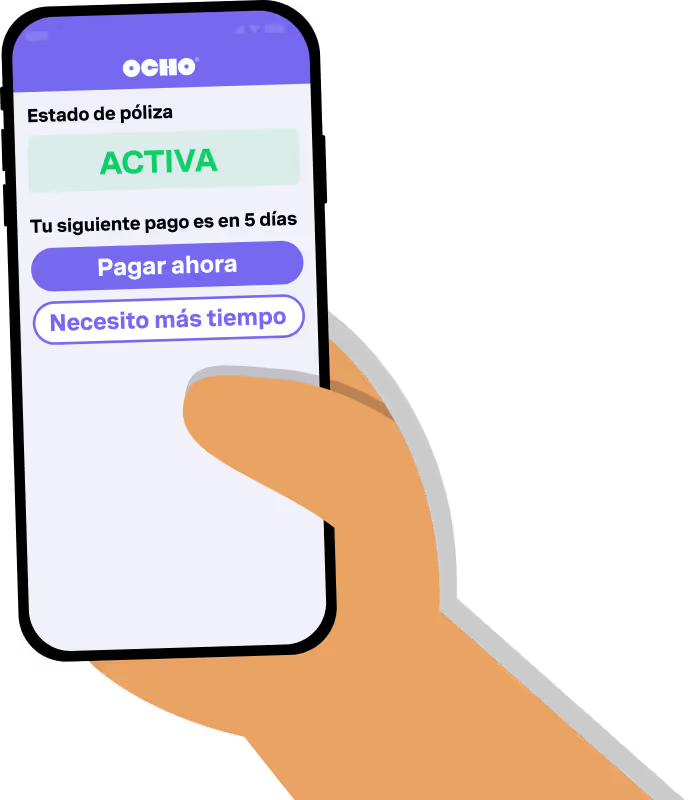
Gestiona todo en un solo lugar
Realiza un seguimiento de tu póliza, administra los pagos y solicita una extensión de pago directamente desde tu perfil.
Por fin, un seguro de auto que se puede pagar.
Comienza hoy tu camino con OCHO
¡Gracias! ¡Su presentación ha sido recibida!
¡Uy! Algo salió mal al enviar el formulario. Vuelva a intentarlo más tarde.





.svg)