If you've been hit with a DUI in Florida, you've probably heard the term "FR44" thrown around. It sounds complicated, but here's the straight talk on what it means, what it costs, and how to navigate it without losing your mind, or your driving privileges.
Florida FR44 insurance is shorthand for a mandatory FR 44 certificate your insurance provider files with the Florida Department of Highway Safety and Motor Vehicles (Florida DHSMV) to prove you meet special post-DUI insurance coverage rules. It's an add-on filing attached to an existing auto insurance or non-owner insurance policy, not a separate policy you buy off the shelf.
Under section 324.023, Florida Statutes, an FR-44 is required after a DUI conviction for offenses committed after October 1, 2007. The requirement applies regardless of adjudication of guilt to anyone found guilty of, or who pleads guilty or no contest to, DUI under section 316.193. Common triggers include:
Without a valid Florida FR 44 filing on record, FLHSMV will not reinstate your driver's license, even if every fine is paid and every court program is completed.
Florida mandates higher liability insurance limits for FR44 drivers compared to standard drivers. Here's what the numbers look like side by side:
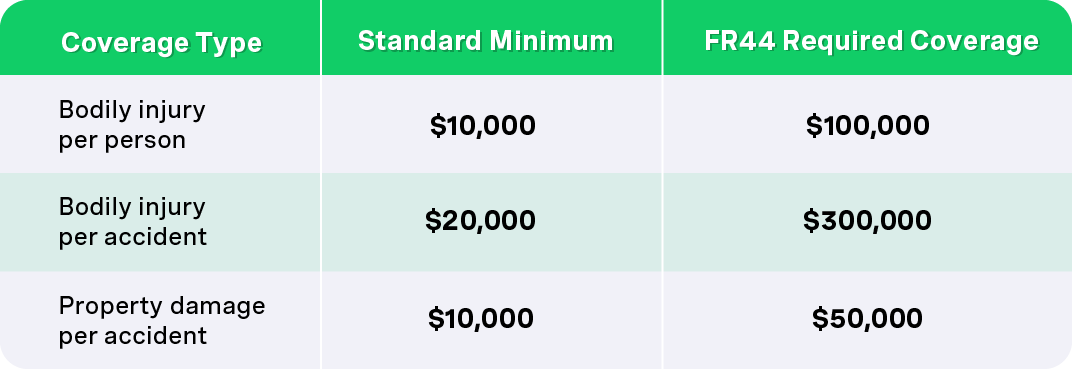
Drivers must maintain 100/300/50 coverage while on FR44. Florida law also allows a $350,000 certificate of deposit instead of a policy, but almost nobody does this because tying up that much money is impractical.
The FR44 requirement attaches to the person, not the vehicle. Whether you own a car, lease one, or borrow your neighbor's truck, the requirement follows your Florida driver's license. Insurance companies must file both the initial FR 44 form and any cancellation notice electronically with FLHSMV, which is why even a one-day lapse gets flagged fast.

A DUI conviction plus higher required limits is a double hit to your wallet. The FR 44 filing fee itself is usually small, but the real cost comes from being classified as high risk and forced into higher liability limits.
Insurance companies may cancel coverage after a DUI conviction, leaving you with fewer options. Many standard insurers won't write FR44 policies at all, pushing Florida drivers into non-standard markets where car insurance rates vary based on factors like:
To keep costs down: start comparing quotes from multiple carriers, consider cheaper vehicles, raise your comprehensive coverage deductibles where it makes sense, and ask about non-owner FR44 if you don't own a car.
FR44 and SR 22 are both certificates of financial responsibility, but they serve different purposes. In Florida, SR 22 handles some suspensions like uninsured crashes, while Florida FR 44 is reserved specifically for DUI cases with higher liability limits and stricter compliance.
Only Florida and Virginia use FR44. Most other states rely solely on SR 22. Virginia's FR44 requires 100/200/50 after their minimums increased in January 2025, while Florida demands 100/300/50, meaning an FR 44 requires $300,000 total for bodily injury liability per accident in Florida.
If you move out of state, your Florida FR44 obligation doesn't vanish. You must satisfy it until FLHSMV releases the requirement, regardless of what your new state's DMV asks for. FR44 in any state is not a separate policy but a filing attached to underlying auto insurance.
Florida FR44 insurance must be maintained for three years from the date FLHSMV reinstates your driver's license, not from the date of your DUI arrest, as long as you have no new DUI or felony traffic convictions during that time. You can't "wait it out" while your license sits suspended.
A lapse in FR 44 coverage leads to immediate penalties. Here's what counts as a lapse: policy cancellation, non-payment, switching to coverage without FR44 limits, or non-renewal without replacement. All get reported to FLHSMV through a cancellation notice from your insurer.
Consequences of a lapse include:
Avoid lapses by enrolling in automatic payments, keeping your contact details current with your insurance carrier, renewing early, and confirming that any new insurer has filed the FR44 before you cancel the old policy.
Since the FR44 requirement is linked to the person, you need an FR44 filing even if you don't currently own a vehicle but want to restore your driving privileges.
Before choosing a non-owner FR44, confirm with Florida DHSMV and your insurer that this type of policy will satisfy your specific requirement and allow your Florida driver's license reinstatement.
Getting from a DUI conviction back to legal driving status follows a clear sequence:
Below are answers to common questions that go beyond what's covered above.
No. Under Florida law, the FR44 requirement is time-based, not performance-based. FR-44 coverage is required for three years from the date your license is reinstated, and safe driving doesn't shorten that window. Verify your end date directly with FLHSMV before asking your insurer to drop the filing. Once removed, you can lower your required coverage to standard minimums (subject to lender requirements), and your premiums should decrease over subsequent renewal cycles.
Moving doesn't erase your obligation. You must maintain a policy meeting Florida's 100/300/50 FR44 standards until FLHSMV clears the requirement. Work with an insurer licensed in your new state who can still file and maintain a Florida FR44. Speak with both Florida DHSMV and your new state's DMV to avoid getting caught driving with a suspended license.
Not every DUI arrest triggers FR44. Only a qualifying DUI conviction or plea under section 316.193 does. If charges are reduced to reckless driving or dismissed, FR44 may not apply, though other consequences like SR 22 or standard penalties could still follow. Review your final court disposition and DHSMV correspondence carefully, since those documents specify exactly what's required.
Yes, and it can actually save you money since different companies rate FR44 and DUI risk differently. The safe sequence: secure a new FR44-compliant policy first, confirm the new insurance company files the FR 44 form with FLHSMV, then cancel the old policy only after the new filing is accepted. Even a one-day gap means a lapse, and failure to maintain FR44 can result in license suspension all over again.
The FR44 filing itself is the same proof of financial responsibility certificate whether it's attached to a motorcycle policy or a standard auto insurance policy. Liability limits must still meet the 100/300/50 requirement. However, premiums and underwriting rules differ from regular car insurance. Confirm with your insurer that your motorcycle policy can carry the FR44 filing and satisfies all Florida law requirements for license reinstatement.
Compara y obtén cobertura rápido
Encuentra y compara seguros de auto en minutos y obtén su puntaje de crédito gratis.
Elige cuando pagar
Selecciona fechas de pago que coincidan con tu día de pago de sueldo.
Gestiona todo en un solo lugar
Realiza un seguimiento de tu póliza, administra los pagos y solicita una extensión de pago directamente desde tu perfil.