If you only drive a few days a week, why should you pay the same insurance bill as someone who commutes daily? That’s the idea behind pay by the day car insurance—coverage that matches what you actually use. For drivers with tight budgets or irregular paychecks, this flexibility can mean the difference between staying legal on the road or risking a costly lapse.
Here’s the thing: OCHO doesn’t literally sell per-day on/off policies. But we help drivers get low-cost coverage and pay for it in smaller, paycheck-friendly chunks that feel just like “pay as you go.” The result? You can avoid debt, sidestep coverage gaps, and keep money in your pocket.
Pay by the day car insurance means exactly what it sounds like: you pay for active coverage only on the days you actually drive your vehicle, instead of a flat monthly bill that stays the same whether your car moves or sits parked in the driveway for a week.
This differs sharply from standard 6- or 12-month policies. With traditional insurance, you’re locked into the same premium whether you drive 30 days a month or 3. Your insurer doesn’t care if the car collects dust—your bill stays the same.
Some insurtechs in the U.S. and UK offer true day-to-day activation, letting you toggle coverage on and off via a phone app. However, most major U.S. insurers still sell only traditional term policies. They haven’t caught up to what many drivers actually need.
Related models share the same philosophy:
The core idea is identical across these types: your bill tracks how much you actually use your car.
Here’s a simple example: if you only drive 8–10 days a month, paying by the day can cost significantly less than a full-time policy—assuming the pricing is fair and transparent.
Pay-by-day coverage works best for people who drive rarely or inconsistently. If you’re behind the wheel every single day commuting to work, this probably isn’t your best fit. But for a lot of drivers, it makes perfect sense.
City dwellers who rely on public transit often keep a car for weekend errands or occasional trips. Paying full price for coverage that sits unused five days a week doesn’t add up.
Gig workers with irregular schedules might drive for deliveries a few days one week, then not at all the next. Traditional policies ignore this reality completely.
Students home for holidays need coverage for a short period—maybe a month or two—then nothing until the next break. Why pay year-round?
Families with a second or third vehicle that rarely moves could save money by only covering it when it’s actually in use.
OCHO’s core audience—working-class drivers with tight budgets, irregular paychecks, or credit challenges—often falls into these categories. You need to stay legal on the road, but you can’t afford massive upfront deposits that traditional companies demand.
If you’re in a state with expensive insurance like California, Florida, or New York, usage-based models can deliver especially large savings. The math just works better when you’re not subsidizing coverage for days you never drive.
One important note: if you drive daily or rack up long miles (think delivery drivers or long-distance commuters), you may actually save more with a traditional policy plus flexible payment plans. Per-day coverage can get expensive fast if you’re on the road constantly.
Many pay by the day products use apps or websites to let drivers turn coverage on for the days they drive and pause it when the car is parked. It’s designed to be simple—control your coverage from your phone in seconds.
Here’s the typical process:
Behind the scenes, insurers still underwrite you like any other driver. They look at your age, driving history, location, vehicle type, and other details to calculate your risk profile. Then they convert that into a daily price instead of a monthly one.
Some insurers meter usage by actual calendar days. Others track miles or even driving minutes. Either way, your bill shows smaller, more frequent charges instead of a big lump sum that can wreck your budget.
What about proof of insurance? Once a day is activated, you receive instant digital documents—ID cards you can show to police, lenders, or rental agents. No waiting for mail or fumbling with paperwork.

When you’re considering pay by the day car insurance, it’s important to know exactly what kind of protection you can get for your vehicle—especially if you only need coverage for a short period or for specific situations like borrowing a car. Unlike traditional auto insurance plans that lock you into long-term commitments, pay by the day coverage lets you choose the level of protection that fits your needs for each day you drive.
Liability coverage is the foundation of any car insurance policy, and it’s usually required by law. This type of coverage pays for property damage liability and injuries you might cause to others in an accident, even if you’re only driving for a single day. It’s a must-have if you want to stay legal and protect your finances in the event of a mistake behind the wheel.
If you want extra peace of mind, you can add collision coverage to your pay by the day insurance. This option helps cover the cost of repairing or replacing your own car if you’re involved in an accident, regardless of who’s at fault. It’s especially useful if you’re borrowing a vehicle or driving a car that you don’t own outright, since you’ll want to avoid unexpected repair bills.
For even broader protection, comprehensive coverage is available with many pay by the day plans. This covers damage to your vehicle from non-collision events—like theft, vandalism, or weather—on the days your insurance is active. If you only need coverage for a short period, you can activate comprehensive protection just for those days you’re actually using the car.
The flexibility of pay by the day car insurance means you can tailor your coverage to match your driving habits. Whether you’re borrowing a friend’s car for a weekend, taking your own vehicle out of storage for a day, or just need insurance for a short period, you can choose the right mix of liability, collision, and comprehensive coverage to fit your situation—without paying for days you don’t drive.
By understanding your coverage options, you can make sure you’re protected every time you get behind the wheel, while still keeping your insurance costs under control.
Pay-by-day car insurance isn’t perfect for everyone. Like any financial product, it offers real benefits alongside important tradeoffs you need to understand before buying.
Lower costs for light drivers. If you only drive a few days a week, you stop paying for coverage you don’t use. That’s money back in your pocket.
Avoid large upfront payments. Traditional insurers often demand hefty deposits. Daily models spread the cost into small, manageable charges.
Easier budgeting. Small daily charges are easier to plan for than one big monthly bill—especially if your paycheck is irregular.
Pause coverage for stored vehicles. Have a car in storage for the winter? Don’t pay for coverage you can’t use. Turn it off until you need it again.
Risk of forgetting to activate. If you forget to turn coverage back on before driving and get into an accident, you’re treated as uninsured. That’s a serious mistake with major consequences.
No coverage on “off” days. Your vehicle isn’t protected against theft, vandalism, or weather damage when coverage is paused.
Fewer providers in the U.S. Major companies don’t typically offer true daily policies. Your options are limited.
Potentially higher costs for frequent drivers. Drive more than expected? Your bill can exceed what a traditional policy would have cost.
Lender and lease restrictions. Many car loans and lease agreements require continuous full coverage. On/off daily insurance may not be applicable to financed vehicles.
Before committing, honestly estimate how often you drive in a typical week or month. Then compare estimated daily costs against a standard monthly policy with flexible payments. The numbers don’t lie.
While OCHO doesn’t literally sell per-day on/off policies, we help U.S. drivers get traditional coverage that can be paid in small, flexible installments matching their pay cycle. The result feels very similar to pay-as-you-go without the risks of gaps in coverage.
Here’s how our model works:
OCHO is a digital broker that compares real-time quotes from multiple insurance companies. We find you competitive rates, then we front or finance the big down payment with 0% interest. That means you can start with little or $0 down—no borrowing from credit cards at outrageous rates.
You can align your payments with bi-weekly, or monthly paychecks. A standard 6-month policy suddenly feels more like a “pay as you drive and earn” plan. Your coverage stays continuous while your payments stay manageable.
We focus specifically on working-class drivers, people with imperfect or limited credit, and underbanked communities. These are the drivers traditional insurers either turn away or charge punishing deposits. At OCHO, we take a bet on you instead.
And here’s something most insurers don’t offer: OCHO can report on-time payments to help customers build or strengthen credit histories over time. You’re not just staying insured—you’re building a better financial future.

Drivers often hear multiple buzzwords—pay by the day, pay-per-mile, usage-based, standard policies—and need a simple comparison to decide what fits their situation best.

With pay-per-mile, you might pay a $25 monthly base rate plus 7 cents per mile. Drive 500 miles? That’s about $60. Drive 1,000 miles? Around $95. The math works in your favor only if you’re a low-mileage driver.
Traditional insurance charges the same whether you drive 100 miles or 1,000. For heavy drivers, this can actually be cheaper than usage-based options.
OCHO can help you see actual quoted prices for these different types (where available) and then layer on flexible, interest-free payment plans to manage any required down payment. You get the information you need to choose wisely.
Getting covered quickly doesn’t have to mean huge upfront costs or confusing fine print—especially when the whole process happens online. Here’s how easy it is:
Step 1: Enter your information. Name, address, date of birth, license number, and your car’s details (VIN or plate number). This takes under 5 minutes on your phone or computer.
Step 2: Compare real quotes. OCHO pulls real-time quotes from partner insurers. You’ll see options for state minimum liability, higher property damage liability limits, and full coverage including collision and comprehensive.
Step 3: Choose your plan. See exactly how OCHO can break up the down payment—often reducing it to $0 upfront. Then schedule payments to match your paycheck dates. No surprises, no hidden changes.
Step 4: Confirm and access coverage. Once your plan and payment schedule are confirmed, you receive instant digital proof of insurance. Use it immediately at the DMV, a dealership, or if you get pulled over.
If you’re considering coverage for a rental vehicle, most rental companies offer certain types of insurance coverage. Also, if you have a personal auto policy, it may extend to a rental vehicle depending on your policy—talk to your insurance provider to confirm your coverage details.
The whole process happens online. No waiting for agents to call you back, no long phone conversations, no physical documents you might lose. Just click, check your options, and start driving legally.
If you have questions or need help, you can contact OCHO’s support team for assistance or visit our FAQ page for more information.
Car insurance is regulated at the state level, so rules vary. While usage-based or pay-by-day structures are generally allowed, not every insurer offers them in every state. Some states require continuous proof of minimum liability coverage, which can limit true on/off day-by-day options—especially for financed vehicles.
Check state-specific rules and use OCHO’s quote flow to see what flexible options are actually available where you live. OCHO currently focuses on helping drivers secure compliant 6-month policies with flexible, budget-friendly payments rather than literal daily on/off coverage.
Most lenders and leasing companies require continuous full coverage—liability plus collision and comprehensive—for the entire term of the contract. Because of this, true on/off daily coverage usually won’t satisfy the finance company’s requirements, especially for newer vehicles.
In these cases, a standard policy combined with OCHO’s flexible payment options is a safer way to stay compliant without facing big upfront costs. Review your loan or lease agreement and confirm coverage requirements before switching to any usage-based product.
Most car insurance policies—whether traditional, pay-by-day, or pay-per-mile—do not automatically report positive payment history to credit bureaus. OCHO is different: we can help customers build credit by reporting on-time payments related to financed insurance costs (where available and permitted).
If credit-building is important to you, prioritize providers like OCHO that explicitly offer this feature. Keep in mind that late or missed payments can still cause problems, so setting up automatic payments aligned with payday is a smart move.
For truly occasional drivers, daily or usage-based pricing can be cheaper because you’re not paying for days you don’t drive. But if you drive nearly every day, a traditional policy often comes out cheaper on a per-month basis.
Estimate how many days a month you actually drive, then compare sample daily costs to an OCHO-powered standard policy with flexible payments. Our quote tool shows real numbers in minutes so you’re not guessing about which option saves more money in your specific situation.
If coverage is off and you get into an accident, you may be treated as uninsured. That means out-of-pocket costs for damages, tickets, possible license suspension, and registration issues. This is one of the biggest risks of true pay-by-day insurance.
Practical safeguards include app reminders, calendar alerts, or simply using a continuous policy with flexible payments (like OCHO offers) to avoid gaps altogether. Keep in mind that driving without active liability coverage is illegal in nearly every U.S. state, regardless of what type of policy you originally signed up for.
Stop overpaying for days you don’t drive. Whether you’re looking for true pay-by-day coverage or flexible payments that make traditional insurance feel just as manageable, OCHO can help you find answers. Get your quote today and see how much you could save—often with $0 down.
Compare & get covered fast
Find and compare auto insurance in minutes, and get your free credit score.
Choose when you pay
Select payment dates that line up with your payday.
Manage everything in one place
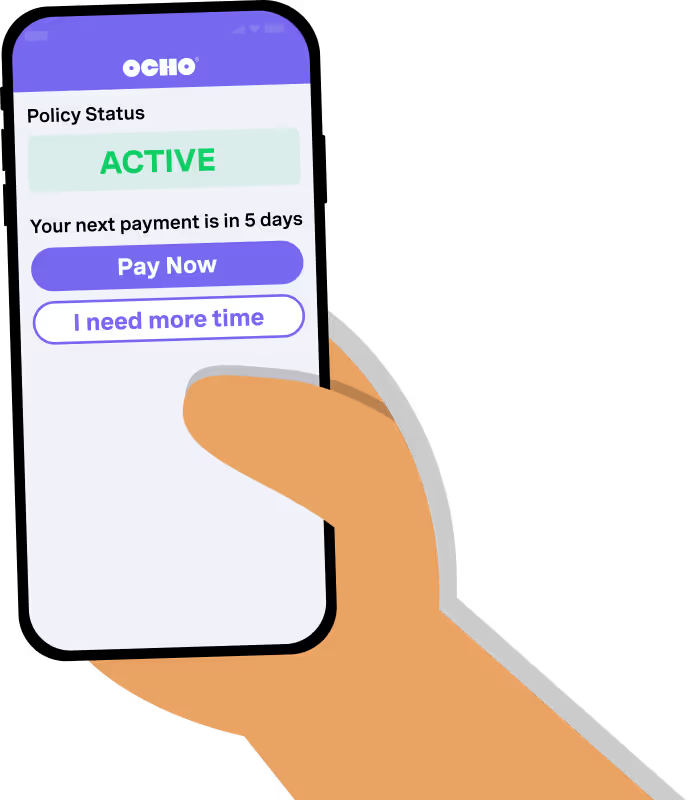
Track your policy, manage payments, and request a payment extension right from your dashboard.




.svg)