Let’s cut to the chase. In 2024–2025, the average driver with a clean record should expect to pay somewhere between $150 and $225 per month for full auto coverage, depending on their state, vehicle, and specific circumstances. If you’re paying $250 or more monthly for a mid-range vehicle and you haven’t had any accidents or tickets, something’s probably off.
The easiest way to know if you’re overpaying is to run through this quick self-assessment. Be honest with yourself—your wallet depends on it.
Are you probably overpaying? Check these:
If you answered “yes” to at least 2–3 of these items, you’re very likely paying too much for car insurance. Keep reading—we’re going to fix that.
Here’s a concrete example: Let’s say you’re paying $210 per month ($2,520 per year) for a 2014 Honda Civic with a clean record in a mid-risk state like Ohio or Georgia. That’s above typical market ranges for that profile. You should absolutely shop around and compare rates from multiple insurance providers.
One important caveat: if you have high-risk factors like recent accidents, a DUI, or multiple speeding tickets, or if you live in a very high-cost state (Louisiana, New York, Michigan, Florida), your higher premiums might actually be justified. That doesn’t mean you shouldn’t shop around—it just means your baseline will naturally be higher than the average driver.
Insurance companies use dozens of data points to calculate your premium. But here’s the thing—most people can focus on a core set of factors to judge whether their price is fair or inflated.
Some factors are completely under your control: your claim history, the car you drive, your coverage choices, and your deductible levels. Others are mostly outside your control: your age, where you live, and broader market conditions affecting insurance rates in 2025. Understanding the difference helps you figure out where to focus your energy.
Consider two drivers with identical vehicles. Driver A lives in a rural Iowa ZIP code with minimal traffic and low theft rates. Driver B lives in downtown Detroit with higher accident frequency and vehicle theft. Driver B will legitimately pay hundreds more per year—not because they’re being ripped off, but because they represent more risk to insurers. The following subsections break down these factors so you can evaluate your own situation.
Insurers care deeply about your past behavior because it’s their best predictor of future claims. When they price a 6- or 12-month policy, they’re essentially betting on whether you’ll cost them money during that period.
A clean driving record for 3–5 years typically earns you the best car insurance rates. On the flip side, a recent at-fault accident or DUI can double your insurance premiums for anywhere from 3–7 years, depending on your state and insurer. That’s not a typo—one bad incident can affect your pricing for the better part of a decade.
Even “small” claims matter more than you might think. A $1,200 fender bender you filed in 2023 can increase your rates for several renewal cycles. Multiple claims since 2022? That’s a strong reason why your policy might be expensive, and unfortunately, that part might be justified.
Here’s where it gets interesting: if you’ve had no at-fault accidents, tickets, or claims since at least 2021, but you’re still paying noticeably above your state average, you may be overpaying. Different insurance companies weigh minor violations differently—some barely blink at a single 5–9 mph speeding ticket, while others treat it like a major infraction. This is exactly why comparison shopping matters so much.
The vehicle you drive and how you choose to insure it directly affect your premium size. This is where many people unknowingly waste money.
Newer, higher-value vehicles cost more to insure. A 2024 SUV worth $45,000 will naturally carry higher car insurance premiums than a 2012 Toyota Corolla worth $5,000. The logic is simple: if the insurer has to pay out a claim, they’re on the hook for more cash with the newer car.
Understanding collision and comprehensive coverage versus liability is crucial here. Liability covers damage you cause to other vehicles and people—it’s required in almost every state. Collision and comprehensive cover your own vehicle. Here’s a rule of thumb that could save you serious money: if your annual comp and collision premiums exceed roughly 10% of your car’s actual cash value, the coverage may not be cost-effective.
Let’s put real numbers to this. Say your car is worth $3,000, and you’re paying $600–$700 per year just for comprehensive and collision coverage. You’re essentially paying 20%+ of your car’s value annually to protect it. If you could afford to replace the vehicle out of pocket (or simply move on without it), dropping those coverages could significantly lower your costs.
And don’t overlook your deductible choice. Moving from a $500 to $1,000 deductible can reduce the collision and comprehensive portion of your premium by 15–25%. The catch? You need to be able to cover that higher out-of-pocket amount if you’re in an accident. Don’t set a $2,000 deductible if you don’t have $2,000 in savings.
Insurers price risk differently across ZIP codes. They’re looking at theft rates, vandalism frequency, accident statistics, severe weather events, and the prevalence of uninsured drivers in your area.
The differences can be dramatic. Dense urban ZIP codes in states like New York or California often cost significantly more than rural ZIP codes in states like Iowa or Idaho. This isn’t arbitrary—it reflects real differences in claim frequency and severity.
Annual mileage and commute patterns also affect your rates. Many insurers offer “low mileage” pricing for drivers under 7,500 miles per year, or for those working from home 3–5 days per week. Here’s a scenario that might sound familiar: someone went fully remote in 2022 but never updated their insurance policy. They’re still being rated as a 40-mile-per-day commuter and paying more than necessary. If that’s you, one phone call could lower your premium.
Keep in mind that moving from one ZIP code to another—even within the same city—can legitimately change your rate. But if you see a large, unexplained jump without any change in your driving record or coverage, that should be questioned with your insurer.
In most states, insurers use a credit-based insurance score to help predict claim likelihood. Your credit doesn’t reflect how well you drive, but statistically, it correlates with claim frequency. Fair? That’s debatable. Reality? It’s how the system works.
Some states restrict or prohibit this practice entirely. California, Hawaii, and Massachusetts, for example, don’t allow insurers to use credit in auto insurance pricing. If you live elsewhere, your credit matters.
The good news: improving your credit from “poor” to “good” over a few years can lower premiums by hundreds of dollars annually. If you’ve made significant credit improvements recently, ask your insurer to re-rate your policy. Better yet, shop around—some insurers may now view you as a much lower risk.
Payment history with insurance companies also matters. Frequent payment issues, policy cancellations for non-payment, or gaps in coverage (like letting a policy lapse for even a month in 2023) can raise your rates. Maintaining continuous coverage almost always earns you better pricing.
If you’ve cleaned up late payments or resolved debts since 2022, it’s time to compare quotes. You might qualify for much better rates than you’re currently paying.
The only way to truly know if you’re paying too much is to compare your current premium against realistic benchmarks: state averages and competing quotes for the exact same coverage.
In 2024–2025, average full-coverage premiums vary significantly by state. Drivers in Maine or Idaho might pay around $1,400–$1,800 annually, while those in Louisiana or Michigan could face $3,500 or more for similar coverage. These aren’t obscure statistics—they’re publicly available from state regulators and consumer reports. Knowing your state’s average gives you a baseline.
When gathering quotes, compare apples to apples. That means same liability limits, same deductibles, same drivers listed, same car, and similar annual mileage. A quote for minimum coverage is useless if you currently carry full coverage.
Here’s a practical rule: if multiple competing quotes are at least 10–20% lower than what you currently pay for comparable coverage, you’re likely overpaying with your current provider. That’s your signal to seriously consider switching.
Make it a habit to re-benchmark at major life events: buying a new car, moving, getting married, adding a teen driver, or having old claims fall off your record. Even without major changes, checking every 12–24 months keeps you from leaving money on the table.
You have two main options for comparison shopping: online quote tools or working with an independent insurance agent. Each has trade-offs.
Independent agents can pull quotes from multiple companies at once and help interpret differences in coverage wording. If you find policies confusing or don’t want to fill out multiple forms, an agent can save you time and potentially catch coverage gaps you’d miss on your own.
If you go the online route, come prepared. Have your driver’s license numbers, VINs, current coverage limits, and odometer readings ready. This speeds up comparisons and ensures you get accurate quotes.
Aim to collect at least 3–5 quotes within the same week. In 2024–2025, many insurers are frequently updating rates, so quotes can change quickly. Shopping over several weeks might give you inconsistent comparisons.
One more tip: some large insurers have temporarily paused writing new policies in certain states due to profitability concerns. Don’t limit yourself to household names. Regional companies and smaller brands often uncover better deals that the major players can’t match.
While some price differences between drivers are normal and justified, certain situations are strong indicators that your premium is unnecessarily high. These aren’t subtle hints—they’re red flags.
You’re probably overpaying if:
That loyalty penalty is real. Insurance companies often gradually increase prices on long-term customers, counting on inertia to prevent them from shopping around. Industry-wide increases between 2020 and 2024 made this worse. If you’ve been “loyal” for years without checking alternatives, you’re almost certainly paying too much.
Let’s look at some real-world situations where drivers commonly waste money without realizing it.
The Low-Mileage Retiree: Patricia retired in early 2023 and now drives maybe 3,000 miles per year—mostly to the grocery store and occasional doctor appointments. But her policy still rates her as a full-time 40-mile commuter because she never called to update it. She’s paying roughly $1,800 per year when similar low-mileage drivers in her area pay around $1,100–$1,300. Correcting her mileage classification and shopping around could save her approximately $500 annually.
The Paid-Off Sedan with Excessive Coverage: Marcus finished paying off his 2010 Honda Accord in 2022. The car’s worth maybe $4,500 on a good day, but he still carries full coverage with a $250 deductible because that’s what his lender required. He’s paying $1,400 per year. By dropping collision and comprehensive (and pocketing that $600+ annual savings instead), he could self-insure for any damage to his aging vehicle while maintaining liability protection.
The Life Changes Left Unreported: Jamie got married in 2023 and moved from an urban apartment to a suburban house with a garage. She never updated her address or marital status with her insurer. She’s being rated for both a higher-risk ZIP code and single-driver status when she should be getting married-homeowner discounts in a safer neighborhood. Her current $2,400 annual premium could potentially drop to around $1,800–$2,000 with accurate information.
Do any of these sound like you? If so, you’ve just identified your action items.

Now that you’ve confirmed you might be overpaying, it’s time to take action. There are three main levers you can adjust: your coverage structure, your driving-related behaviors and reporting, and your shopping strategy.
The following sections walk through each area. Here’s an important insight: savings often come from combining several smaller changes rather than making one dramatic move. Raising your deductible alone might save $150. Updating your mileage might save another $100. Removing a no-longer-needed driver might save $200. Switching companies might save $300. Stack them together, and suddenly you’re looking at $750+ in annual savings.
Quick example: Sam saved about $500 per year by increasing deductibles from $500 to $1,000, dropping comp/collision on an older car worth under $4,000, and switching insurance providers in early 2025. None of those individual moves was revolutionary—but combined, they made a meaningful difference.
Cutting coverage can backfire badly if you cut the wrong things. Being underinsured after an accident is far more expensive than being slightly over-insured beforehand. Proceed carefully.
Liability coverage—which pays for bodily injury and property damage you cause to others—should be the last thing you reduce. State minimums are often dangerously low. Many experts recommend at least $100,000 per person / $300,000 per accident / $100,000 property damage for drivers with any meaningful assets to protect. If you cause a serious accident with only state-minimum coverage, you could be personally liable for hundreds of thousands in damages.
Collision and comprehensive coverage is where you have more flexibility, especially on older, lower-value vehicles. Use that 10% rule: if annual comp and collision premiums exceed 10% of your car’s value, reconsider. A car worth $5,000 with $800 per year in comp/collision is borderline. A car worth $3,000 with the same premium? You’re probably better off self-insuring.
If you have a lease or a recent loan and owe more than the car’s current value, gap coverage matters. Removing gap coverage too early can leave you owing money on a totaled vehicle. Check your loan payoff against your car’s value before making changes.
Finally, review your add-ons. Rental reimbursement is valuable if you’d struggle without a car during repairs. Roadside assistance might be redundant if you already have AAA or similar coverage through another membership. Custom equipment coverage only matters if you’ve actually customized your vehicle. Keep what helps you; trim what doesn’t.
Your deductible is the amount you pay out of pocket before insurance kicks in after a covered claim. Higher deductible = lower premium, but more financial exposure when something happens.
Typical deductible options range from $250 to $2,000 or more. Here’s a realistic example: moving your comprehensive and collision deductible from $500 to $1,000 might save $150–$300 per year for a mid-priced car, depending on your state and insurer. Over three claim-free years, that’s $450–$900 in savings.
The critical question: can you comfortably cover the higher out-of-pocket cost from savings or an emergency fund? If a $1,000 surprise expense would wreck your finances, keep the lower deductible. The premium savings aren’t worth the financial stress if you actually need to file a claim.
Some drivers should keep deductibles moderate rather than maximizing them. If you have a new, financed car, your lender may have deductible requirements. If you’ve filed multiple claims in recent years, you’re statistically more likely to need the coverage. And if you have a long commute in heavy traffic, your exposure to minor incidents is higher.
Re-evaluate your deductibles whenever your car’s value significantly decreases (typically 3–5 years after purchase) or when you’ve built a stronger emergency fund. What made sense when you bought the car might not make sense today.
Many people overpay simply because they haven’t updated their discount profile or taken advantage of programs designed to reward good driving habits.
Common discounts to ask about:
Usage-based or telematics programs deserve special attention. These involve installing a device in your vehicle or downloading a mobile app that tracks your driving habits. Safe drivers who demonstrate consistently good behavior (smooth braking, reasonable speeds, low mileage) can save 10–30% on their premiums. The trade-off? Privacy concerns and the risk that demonstrating unsafe habits could actually raise your rates.
Bundling auto and homeowners insurance (or renters insurance) with the same company typically saves 10–25%. But don’t assume bundled is always cheapest—compare the bundled package against separate policies from different carriers. Sometimes the savings from a specialized auto insurer outweigh the bundling discount.
Call your insurer at least once a year and specifically ask which discounts you might be missing. Mention any changes: remote work, older kids off the policy, new safety systems in a replacement vehicle, completed defensive driving courses, or home security upgrades if you bundle. Insurance companies won’t always proactively apply discounts you qualify for.
Switching insurers mid-term is usually straightforward. It’s often the fastest way to correct overpayment.
Here’s a simple process:
There’s generally no penalty for switching at renewal time. If you cancel mid-term, you may even receive a pro-rated refund of unused premium, though some carriers charge small cancellation fees.
Timing matters. If you know a ticket is dropping off your record next month, wait to shop until it’s gone. If your three-year anniversary since an accident is approaching, that’s another optimal shopping window.
Here’s the uncomfortable truth about loyalty: staying with one company solely because you’ve “been with them for years” rarely pays. Data consistently shows that switching every 1–2 years—especially given the significant industry price swings since 2020—often results in better rates than blind loyalty. Your current insurer has no incentive to give you their best price if they know you’re not shopping.
Treating insurance as “set and forget” is one of the biggest reasons drivers pay too much for years at a time. You wouldn’t ignore your credit card interest rate for five years—don’t ignore your insurance premiums either.
Routine review schedule: Check your coverage and compare quotes at least once every 12 months. If your auto policy renews every 6 months (common in many states), that renewal notice is your reminder to at least glance at competing options.
Life events that should trigger an immediate review:
Set a digital calendar reminder 2–3 weeks before each renewal date. That gives you time to gather quotes, make decisions, and avoid last-minute scrambling.
Consider keeping a simple one-page summary of your coverage and premiums from each year. Note your 2022, 2023, 2024, and 2025 premiums along with your coverage levels and deductibles. This makes patterns obvious and helps you spot sudden increases that demand explanation.
The questions below address common situations that weren’t fully covered in the main sections. If you still have questions after reading, comparing quotes from multiple companies is almost always the right next step.
Small increases of 5–10% at renewal can be normal, especially in years with rising claim costs industry-wide. Inflation affects repair costs, medical expenses, and vehicle values—all of which influence what insurers pay out on claims.
However, jumps of 20% or more without any tickets, accidents, or coverage changes are a red flag. Call your insurer and ask for a specific breakdown of why your rate increased. Sometimes it’s a statewide rate filing that affected everyone. Sometimes it’s a mistake. Sometimes they’re just betting you won’t bother to shop around.
In 2024–2025, some states saw statewide rate hikes push average premiums up by double digits due to increased storm damage payouts and higher repair costs. But not all insurers raised prices equally—which is exactly why getting competing quotes matters even if your increase seems “normal.”
It usually makes sense to consider dropping collision and comprehensive coverage once your car’s value falls low enough that you’d be comfortable walking away or replacing it out of pocket if it were totaled.
A reasonable rule of thumb: if your car is worth under about $3,000–$5,000 and you’re paying several hundred dollars per year for comp and collision, you may be over-insuring it. Calculate whether those premiums could build a “replacement fund” faster than insurance would pay out.
Important exception: if you still have a loan or lease on the vehicle, your lender almost certainly requires full coverage. Don’t drop it until the loan is cleared and you’ve verified there are no contractual obligations requiring collision and comprehensive coverage.
Switching insurers does not hurt your credit score. The soft credit checks insurers commonly use when generating quotes typically don’t affect your credit at all—they’re inquiry types that aren’t visible to other lenders.
Your driving record stays with your state’s DMV and is visible to all insurers regardless of how often you switch. Changing companies does not erase tickets, accidents, or claims from your history. That information follows you everywhere.
Focus on getting the right coverage at the right price. Shopping around is expected consumer behavior, not something that creates problems for you.
Minor tickets (like a single speeding violation for 10 mph over) typically affect premiums for about 3 years in most states. More serious violations like DUIs can impact your pricing for 5–10 years depending on state law and insurer policy.
At-fault accidents generally stay “chargeable” on your record for 3–5 years. Some insurers offer accident forgiveness programs that prevent your first at-fault accident from raising your rates, but these often require you to enroll before the accident occurs.
Mark on your calendar when a significant ticket or accident will “age off” your record based on your state’s rules. Shop around shortly before or after that date to capture potential savings—some insurers may already be willing to quote you lower rates as that date approaches.
Yes, insurers can choose not to renew your policy in many states if you accumulate multiple claims or serious violations. However, they’re typically required to send you advance written notice (often 30–60 days) before non-renewal, giving you time to find alternative coverage.
Frequent small claims—even minor glass repairs or parking lot incidents that weren’t your fault—can make your coverage more expensive and may contribute to a non-renewal decision. Not-at-fault claims still appear on your record and signal to insurers that you file claims frequently.
Before filing a claim for minor damage, weigh the repair cost against likely premium increases. If the damage is only slightly above your deductible, paying out of pocket often makes more financial sense than filing and potentially seeing your rates climb for years afterward.
Compare & get covered fast
Find and compare auto insurance in minutes, and get your free credit score.
Choose when you pay
Select payment dates that line up with your payday.
Manage everything in one place
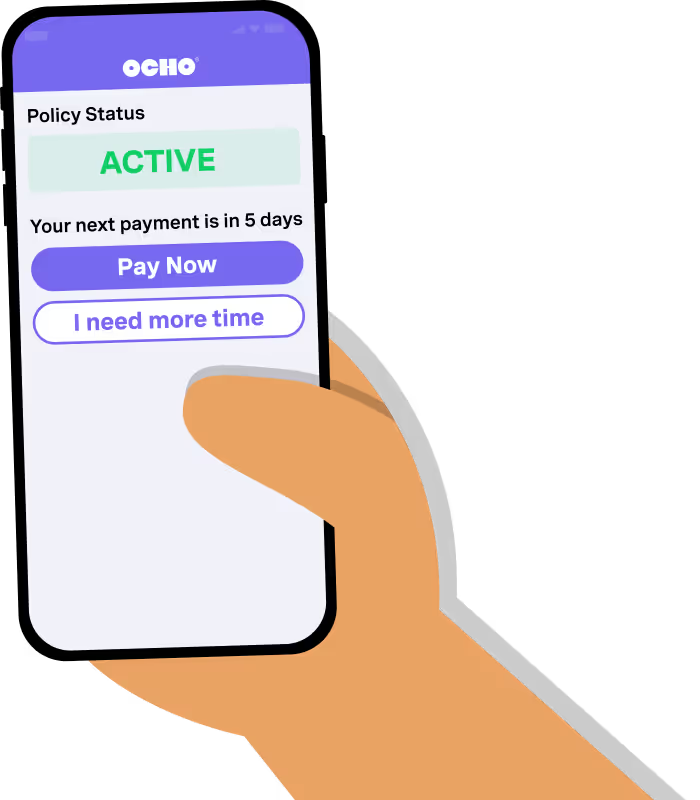
Track your policy, manage payments, and request a payment extension right from your dashboard.




.svg)