Getting car insurance without draining your bank account upfront sounds too good to be true—but it’s closer to reality than most people think. Many drivers expect to pay a large upfront payment because traditional insurance models require hefty deposits, but new options like OCHO’s no-deposit approach are changing that. Let’s break down what no down payment car insurance actually means and how to make it work for your wallet.
Affordable car insurance options are available for drivers with limited financial resources.
Here’s the deal: traditional car insurance companies like Progressive, Geico, and State Farm almost always require some money before your policy starts. Many major insurers, such as Progressive, do not offer true 'zero down' plans, which may limit choices to smaller or non-standard carriers. That’s just how they operate—they take on risk the moment your coverage begins, so they want skin in the game. Most reputable car insurance companies will require some form of initial payment before your policy goes into effect. However, brokers and insurtechs like OCHO can front that cost and let drivers start coverage with $0 out-of-pocket on day one. OCHO is the only place offering true $0 down because we finance the down payment. OCHO offers flexible payment options that allow customers to start their coverage with minimal or no upfront costs, and provides instant approval for car insurance policies, allowing coverage to begin immediately after application. OCHO's no deposit car insurance eliminates the financial barrier of large upfront payments, making coverage more accessible.
What does “no down payment” or “no deposit car insurance” typically mean? In most cases, you’re paying at least your first month’s premium before coverage kicks in. No down payment car insurance typically requires you to pay a portion of your total premium before starting your coverage. Some insurance companies use terms like 'no deposit' to refer to policies that still require an initial payment, often equivalent to the first month's bill. The difference now is that financing options can eliminate that painful lump sum.
Three main ways to avoid a big upfront bill:
To get started, customers can complete a simple online form to apply for no deposit car insurance.
Think about it: instead of scrambling for a $600 lump sum, you might pay $120 for your first month—or with the right broker, literally $0 today.
Let’s clear up the confusion. “No down payment car insurance” doesn’t mean free coverage. It means paying your initial payment (usually the first month’s premium) to activate your policy, rather than a massive 25-40% chunk paid upfront.
Key terms explained:
Here’s a concrete example: a $1,800 six-month policy billed at $150 per month starting April 1, 2026, activates immediately upon that first $150 payment. What drivers actually want isn’t mythical free insurance—it’s avoiding a $400-$900 deposit when money is tight.
In 2026, most insurers allow monthly payments or split-payment plans, but your initial payment varies by state, risk profile, and carrier rules. Here’s the process to secure coverage without breaking the bank:
Step-by-step approach:
Real example: A Texas driver in Houston in 2026 might see $95/month with $350 down from one carrier versus $120/month with $0 down via financing through OCHO. The monthly rate is higher, but there’s no upfront strain.
Payment date flexibility matters enormously for working-class drivers. Aligning your payment schedule with your paycheck—weekly, biweekly, or semi-monthly—can be just as important as the total premium itself.
Regulations and carrier rules differ by state. California, Florida, and Texas each have distinct requirements, so sometimes you can’t avoid paying something upfront. High risk drivers with recent DUIs or multiple at-fault accidents face stricter down payment requirements.
Your realistic alternatives:
For example, a driver needing SR-22 can’t qualify for $0 down but can reduce the initial hit by choosing state-minimum liability instead of full coverage temporarily.
Many insurers in 2026 allow flexible down payments—sometimes as low as one standard monthly installment if your risk profile is good. Some carriers accept around 10% of a 6-month premium, while others may require 40-50% for higher-risk policies.
Common payment methods include debit card, prepaid card, credit card, or bank account draft. Cash is often only accepted through agents or partner locations.
The tradeoff: Lower down payment usually means higher monthly payments, but it reduces immediate financial strain significantly.
SR-22 is a state filing (required in states like Illinois, Texas, and Florida) after serious violations like DUI or driving without insurance. It proves you carry minimum liability coverage.
SR-22 doesn’t change your coverage itself, but it typically increases premiums 2-3x and reduces your ability to get very cheap car insurance with $0 down. The typical duration is three years—a 2025 DUI might require filing through 2028. Any lapse can restart the clock or lead to license suspension.
Brokers like OCHO can still help SR-22 drivers compare quotes and structure payment plans more flexibly, even when full $0 down isn’t possible.
Take these actions over 3-12 months to qualify for lower premiums:
Most insurers recalculate rates at renewal every 6 or 12 months, so improvements translate to cheaper upfront costs next term.
Tight budgets make drivers vulnerable to misleading ads. Here’s what those phrases actually mean:
Red flags to avoid scams:
Check independent reviews from 2025-2026 to ensure current reliability before you purchase insurance.
When you're hunting for affordable car insurance, you're gonna get hit with all kinds of sweet promises about no deposit car insurance, low down payment deals, or dirt cheap rates. But here's the thing—before you bite, you better dig deeper and make sure these insurance companies aren't about to blindside you with hidden fees and sneaky upfront costs. Because trust us, they will.
Car insurance companies love to wave around their "flexible payment plans" and monthly payment options like they're doing you some huge favor, especially when they know you're strapped for cash. Yeah, these payment options might help you dodge that brutal initial payment hit, but guess what? They're loading you up with extra charges that they conveniently forget to mention upfront. Administrative fees, installment charges, processing fees for using certain payment methods—it all adds up, and suddenly your "cheap" policy is costing you way more than you bargained for. Sound familiar? That's because the system is rigged against you.
Here's how to fight back and secure coverage without getting played:
Some insurtech brokers don’t replace traditional insurers—they work with multiple partner carriers and use financing tools to eliminate upfront costs for customers.
How the model works:
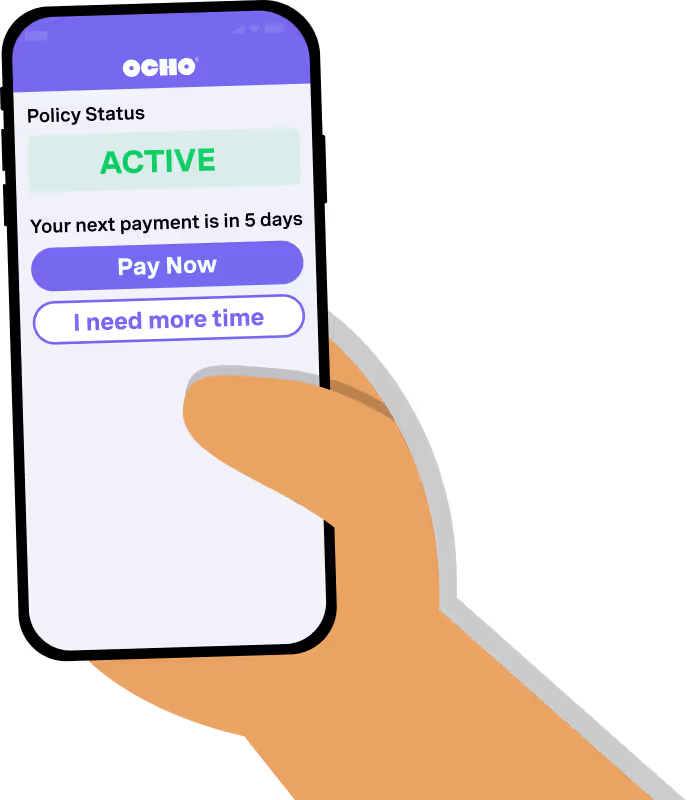
OCHO's insurance offerings align payment schedules with the customer's pay cycle, allowing for better cash flow management. Flexible payment options for car insurance can include monthly or biweekly installments, making it easier for drivers to budget. The entire process is fully online and can be managed directly from your phone, providing instant approval and convenient access to your insurance policy.
This approach converts a painful $400-$800 lump sum into smaller, predictable payments over the six month policy. Coverage itself comes from licensed insurance companies; OCHO acts as the digital agency and payment facilitator.
The application process for no down payment car insurance starts with completing an online form. Make sure to fill out all required fields accurately, as issues with form submissions can delay or affect your ability to receive quotes.
Enter basic info (ZIP, vehicle year/make/model, license, prior coverage dates) and receive multiple quotes showing:
Example: A 2017 Honda Civic driver in Phoenix might see $160/month with $300 down versus $175/month with $0 today via financing. Comparing the upfront requirement matters as much as the monthly price. You can use our simple car insurance calculator to get an estimate with no SPAM.
OCHO’s core feature aligns payments with real-world cash flow:
No interest charges apply—just spreading a fixed cost over time. First repayment might land on your next payday (like May 10, 2026), then every two weeks after.
Once you agree to the plan and e-sign, instant coverage can start the same day—often within minutes. Digital ID cards arrive by email, SMS, or mobile app.
This is critical in states requiring proof of insurance to register vehicles, renew tags, or avoid towing at checkpoints. Timely payments keep your policy active and may help build positive payment history.
Rules about fees, financing, and installment plans vary across states:
Always check quotes for your specific ZIP code and read state-specific notices provided with quotes.
Getting into a policy with minimal money down is only half the battle. Staying insured without lapses keeps rates and deposits low in the future.
Practical tips:
Why lapses hurt: A driver paying $80/month with $100 down before a lapse might face $100/month with $200 down afterward—a 20-40% premium hike and 50%+ deposit increase.
True “pay nothing and drive forever” insurance doesn’t exist with reputable companies. What is realistic in 2026: avoiding huge lump-sum deposits through low down payment options, flexible payment options, and broker-based solutions like OCHO’s $0 today structure. When you decide whether to make a down payment or use a broker-based solution, it's important to consider your budget and payment preferences. Obtaining favorable terms on your insurance policy can help reduce your overall costs.
Digital agencies and insurtech brokers are especially helpful for working-class and underbanked drivers needing instant coverage without producing several hundred dollars on the spot. If you need to file a claim, keep in mind that your coverage and premiums may be affected. Comprehensive coverage can also protect against risks like theft, in addition to other damages.
Your action items:
Getting covered without emptying your wallet is possible—you just need the right approach and the right tools.
Compare & get covered fast
Find and compare auto insurance in minutes, and get your free credit score.
Choose when you pay
Select payment dates that line up with your payday.
Manage everything in one place
Track your policy, manage payments, and request a payment extension right from your dashboard.




.svg)