
If you're trying to compare car insurance quotes without visiting a dozen insurer websites, Compare.com and Insurify are two of the most established platforms in the insurance market. Both let you enter your details once and receive auto insurance quotes from 120+ insurance companies, but they differ in meaningful ways around quote reliability, payment options, and how they help you find the best deal.
The biggest difference comes down to what each platform prioritizes: Compare.com focuses on transparent, bindable quotes with strong privacy protections, while Insurify leans into flexible payment structures and AI-powered tools that go beyond price.
The short answer: Compare.com wins for drivers who value quote accuracy, bindable rates, and a no-spam experience. Insurify is the stronger pick for drivers who need flexible payment schedules, low down payment options, or richer data tools to evaluate insurers beyond price alone. Budget-conscious drivers with tight cash flow should also consider platforms like OCHO that offer $0 down payment car insurance and interest-free financing, features neither Compare.com nor Insurify currently provides at the platform level.

Compare.com is one of the oldest auto insurance comparison sites in the U.S., launched in 2013. It operates as a licensed insurance agency in all 50 states plus Washington, D.C., through its subsidiary Compare.com Insurance Agency, LLC. Since March 2023, it has been a wholly-owned subsidiary of Insurify, though both brands operate independently. If you want help understanding coverage or reviewing policy details, you can also work through a licensed insurance agent on the platform.
Its defining strengths include:
Compare.com says its customers save up to $867 per year on car insurance.

Insurify is a digital insurance marketplace founded in 2013 that uses AI-powered matching to help consumers compare auto insurance quotes from 120+ national and regional providers, with broader auto insurance services that also include access to partner carriers and support through the shopping process.
Its key strengths include:
Insurify has processed over 250 million lifetime quotes and reports user savings of up to $1,100 per year. Customer satisfaction ratings are 4.7/5 on Trustpilot.
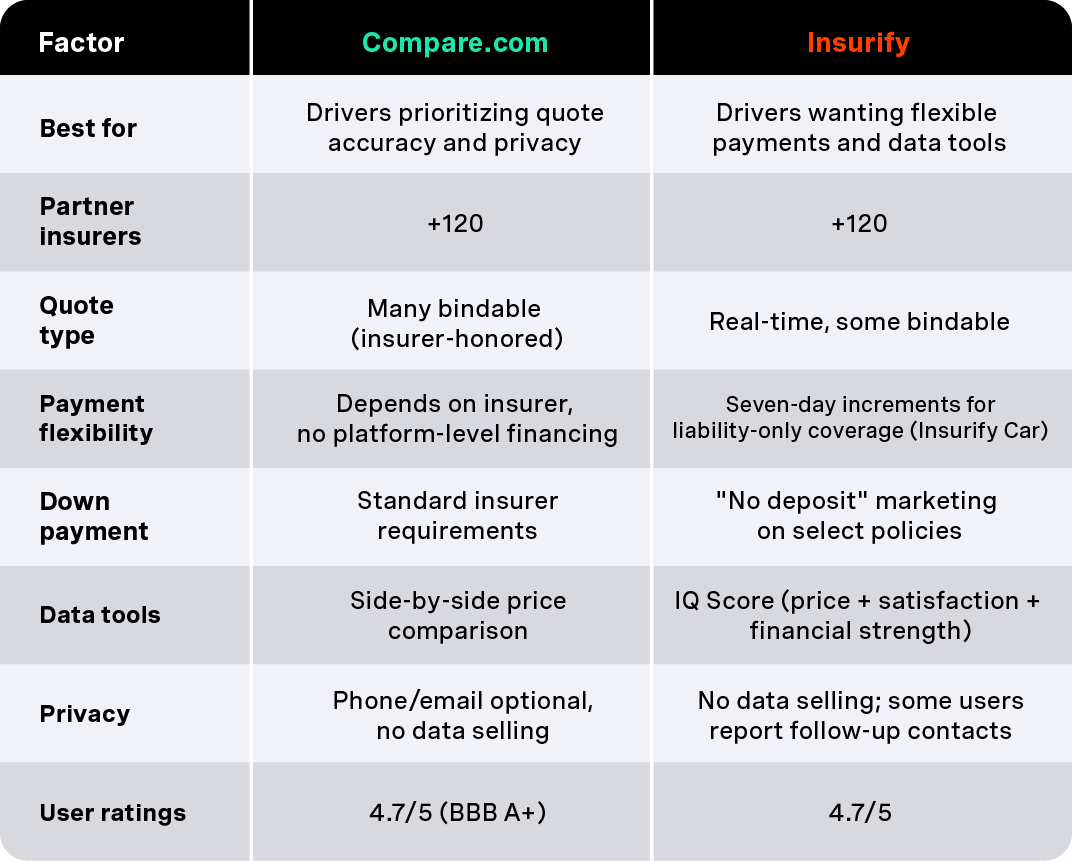
The headline takeaway: both platforms access similar carrier networks, but they differ most in how they handle payments and what data they surface beyond the quoted price.
For many drivers, the upfront cost of car insurance matters as much as the monthly premium. The national average car insurance rate is $2,524 per year, and paying that in a lump sum, or even a hefty first installment, can strain tight budgets. Flexible payment options help drivers with tight budgets manage high upfront auto insurance costs. Payment plans allow split payments aligned with pay cycles, which is critical for workers with irregular income.
Compare.com does not currently offer platform-level financing, $0 down payment options, or interest-free installment plans. The payment schedule you'll get depends entirely on the insurer you select through the platform. Some of those insurers may offer favorable terms, but Compare.com itself doesn't guarantee or control them.
Insurify goes further here. Its Insurify Car program, launched in January 2026, offers seven-day payment increments on liability-only policies, and the platform actively markets "no deposit" and "low down payment" options. However, "no deposit" typically means you still pay the first month's premium; there's no truly zero-cost activation. Insurify's support documentation indicates that initial payments often run around 20% of the total premium. Some insurers charge installment fees for recurring payments, which can add up.
For drivers who genuinely need $0 down payment options for auto insurance or interest-free financing that can cover upfront down payments, neither platform fully delivers. OCHO, for example, offers easy, free car insurance quotes with interest-free down payments and no down payment car insurance with interest-free financing, a feature that fills a gap both Compare.com and Insurify leave open.
Because OCHO provides an interest-free loan to cover your insurance deposit, every on-time repayment is reported and can help build your credit score over time. Neither Compare.com nor Insurify offers credit-building as a built-in platform feature. If building credit through insurance payments matters to you, look for insurers and platforms that explicitly offer this.
Winner: Insurify. It offers more explicit payment flexibility through seven-day billing and "no deposit" options on select products. Compare.com defers entirely to insurer-set terms. That said, neither platform matches dedicated financing solutions for drivers who truly can't afford any upfront cost.
A wider carrier network means more chances of finding the right coverage at a competitive price. Rates for the same driver and vehicle can vary by hundreds of dollars per year between carriers, and comparing quotes from three different companies saves drivers $709 on average. Insurance companies evaluate risk factors differently for quotes, which is why comparing quotes across multiple providers matters so much.
Both Compare.com and Insurify partner with 120+ insurers, making their carrier networks roughly comparable in size. But there are qualitative differences.
Compare.com emphasizes quote fidelity. Its real-time integrations with partner insurer databases mean that comparison platforms query partner insurer databases directly to return accurate pricing. Many quotes are bindable, meaning the insurer must honor the rate if your information is accurate. This reduces the frustrating gap between the quoted price and the final premium that plagues many comparison sites.
Insurify matches on carrier count but adds analytical depth. Its proprietary IQ Score evaluates insurers not just on price but on financial strength, customer satisfaction, transparency, and availability. This gives consumers context that raw price comparisons miss. Analytics and structured algorithms back up the evaluation of risks and coverage options across Insurify's platform.
Both platforms may lack certain major carriers in specific states. Insurance rates vary by state, city, and ZIP code, so the number of available quotes and their competitiveness depend heavily on your location and driving history.
Auto insurance policies often vary in coverage types such as liability and collision, so when comparing, quotes should be compared based on identical coverage limits and deductible amounts to ensure an apples-to-apples comparison. You should also match optional add-ons like personal injury protection, roadside assistance, and rental reimbursement so one quote is not padded with extra benefits the other doesn't include. Liability coverage is required in most states, and minimum coverage is the least amount required by state law, often referred to as liability-only coverage. Liability limits are commonly formatted as 100/300/50, but you may need more depending on your situation. Full coverage premiums can exceed a vehicle's value over time, so matching coverage level to your actual needs matters.
Winner: Tie with an edge to Insurify on data depth. Both offer 120+ carriers. Compare.com wins on quote bindability and accuracy. Insurify wins on giving you richer insurer evaluation tools beyond just price. For the broadest view of what different insurers offer, use both platforms, and consider comparing car insurance quotes across additional sources too, alongside broader guides on how to get affordable car insurance and save in 2026.
When you're shopping for auto insurance, speed matters. No one wants to spend an hour answering questions only to get estimates that change later.
Compare.com produces personalized quote results in under five minutes. Its questionnaire tends to be more detailed upfront, asking a few questions about your vehicle identification number, driving record, and coverage preferences early in the process. This extra detail often means the quotes you see are closer to what you'll actually pay, reducing downstream surprises. The platform lets you skip providing your phone number or email, meaning you can compare car insurance rates without committing to follow-up calls or emails. User privacy is a key feature of reputable comparison platforms; data is not sold to third parties, and Compare.com follows this standard rigorously.
Insurify generally offers a faster, simpler multi-screen flow. AI pre-fill capabilities can speed things up, and the platform's interface feels more modern. However, a simpler initial questionnaire can sometimes mean less precision in early quotes, with adjustments coming after the insurer collects more details like your full driving history, credit profile, or vehicle specifics. Some users report receiving follow-up calls or texts after submitting their information, even though Insurify states it doesn't sell personal data.
Single form entry allows users to input their information once to receive multiple offers on both platforms. Both are significantly faster than calling individual providers or visiting insurer websites one by one. Real-time quotes enable users to see actual rates rather than mere estimates or advertisements.
Quotes require accurate information for best results. Insurance quotes reflect variables like driver age, location, driving history, and accidents, so the more precise your inputs, the more reliable the output. Drivers should compare quotes at least once a year to ensure they're still getting the best deal as accident rates, safety features, and personal circumstances change.
Winner: Compare.com. While Insurify offers a slightly faster flow, Compare.com's combination of more accurate initial quotes and stronger privacy protections (no phone/email required, no spam) makes for a better overall user experience. The time saved by Insurify's quicker form is offset if you later discover the quoted price doesn't hold.
Choose Compare.com if you prioritize quote accuracy and want bindable rates that won't change on you. It's also the better choice if you value privacy: you can compare auto insurance quotes without handing over your phone number or getting bombarded with sales calls. Drivers who want a trusted, no-nonsense platform with an A+ BBB rating and long track record will appreciate its approach.
Choose Insurify if you need more flexible payment options like seven-day billing increments for liability coverage, want "no deposit" style policies, or value seeing insurer ratings beyond just price. It's a strong pick for drivers who want data-driven insights into customer satisfaction and financial strength alongside their car insurance rates.
Consider OCHO if neither platform addresses your biggest pain point. For drivers with tight budgets, irregular pay cycles, or poor credit who need true $0 down payment options, interest-free financing, and credit-building features, OCHO offers capabilities that both Compare.com and Insurify currently lack. Because OCHO finances your insurance deposit as an interest-free loan, on-time repayments build your credit history. No down payment insurance is available for high-risk drivers through OCHO's platform, and plans allow split payments aligned with pay cycles. Guides to pay as you go car insurance with no deposit and OCHO's pay-as-you-go car insurance can help you understand how flexible coverage works in practice.
Comparing quotes can save drivers an average of $709, and drivers can save up to $1,943 by switching insurers. Whichever platform you choose, the act of shopping and comparing car insurance is what delivers the savings. Quotes from at least three companies are recommended for comparison. A lower monthly premium may correspond to higher deductibles or lower coverage limits, and the least expensive option is not always the best value if claims handling is weaker or repair costs end up being harder to cover, so always verify you're comparing the same coverage options at the same coverage level before deciding.
Discounts for auto insurance can significantly reduce overall costs for eligible consumers. Ask about bundling, safe driver discounts, and other drivers on your policy when finalizing any purchase. If you have coverage questions, confirm your choices with a licensed insurance agent.
Can I switch from Insurify to Compare.com after getting quotes?
Yes. Both are independent marketplaces: getting quotes on one doesn't lock you into anything. You can use the same driver and vehicle details on both platforms and buy directly from whichever insurer offers the best deal. Since Insurify owns Compare.com, there may be some overlap in carrier panels, but the platforms operate separately and may surface different rates depending on your profile and location. Customer savings can vary greatly due to differences in insurer risk assessments across platforms.
Does the payment method affect my car insurance rates?
Generally, no. How you pay (monthly, quarterly, annually) doesn't change the base premium an insurer charges. However, some insurers charge installment fees for monthly payments, which increases your total cost. Paying in full upfront sometimes earns a small discount. Neither Compare.com nor Insurify claims that payment method directly affects your rate, but the payment schedule affects your out-of-pocket cash flow, which matters if you're on a tight budget. Interest-free financing options can cover upfront down payments without changing your actual premium, and payment plans that align with your pay cycle can make coverage more manageable.
Which platform is better for drivers with poor credit?
Neither platform offers specialized tools for poor-credit drivers, but they handle credit differently. Compare.com's more detailed upfront questionnaire may produce more realistic quotes earlier, reducing the chance of sticker shock when an insurer pulls your credit report. Insurify's data tools can help you understand how credit history impacts your rates and may surface insurers with more forgiving underwriting. For drivers actively looking to build credit, OCHO's model offers something neither Compare.com nor Insurify currently provides: because OCHO finances your insurance deposit as an interest-free loan, every on-time repayment can improve your credit score. Get a free quote through OCHO to see your options. The actual rates you qualify for depend heavily on your individual risk profile, including your driving record, claims history, and credit score. Your state insurance commissioner is a useful resource for checking insurer complaint data and regulatory oversight.
Compare & get covered fast
Find and compare auto insurance in minutes, and get your free credit score.
Choose when you pay
Select payment dates that line up with your payday.
Manage everything in one place
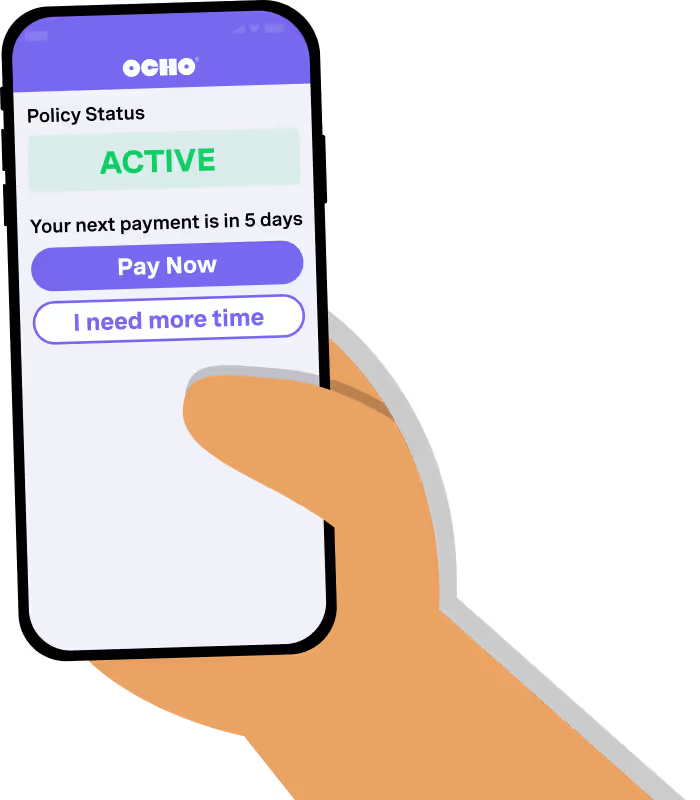
Track your policy, manage payments, and request a payment extension right from your dashboard.




.svg)