Insurance Like Root, Which Usage-Based Car Insurance Is Better for Safe Drivers?
If you're searching for insurance like Root, you're really comparing usage-based auto insurance programs that set rates from tracked driving behavior—and for most drivers, that choice comes down to Root Insurance vs. Progressive Snapshot. Both use telematics to reward safe driving with lower premiums, but they work in fundamentally different ways-and those differences matter more than most comparison sites let on.
For good drivers tired of subsidizing riskier ones, choosing the right usage-based car insurance can mean hundreds of dollars in annual savings. This comparison is for drivers who want to see how Root and Snapshot differ on the factors that actually decide the outcome: how they track you, how pricing and savings work, what app and coverage experience you get, where each is available, and which option makes more sense based on your safety, location, and tolerance for risk.
The single biggest difference: Root requires a mandatory smartphone-based test drive to even qualify for a quote, while Progressive's Snapshot is an optional telematics program layered onto an existing policy. That distinction shapes everything-from savings potential to the risk of being denied insurance entirely.
The short answer: For consistently safe drivers who live in a supported state and want the highest possible savings, Root Insurance offers superior upside-claiming up to roughly $900/year in savings for its safest customers. But Progressive Snapshot is the better choice for most people because it's optional, available in nearly every state, never denies you coverage based on driving data, and still delivers meaningful discounts (averaging about $328/year) with far less risk.
Root Insurance is a mobile-first auto insurance company founded in 2015 that built its entire model around telematics. Unlike traditional insurers, Root determines premiums based on driving behavior captured through its smartphone app during a required test-drive period of approximately 30 days. Root bases its rates on driving habits during this test-drive period rather than relying heavily on traditional factors like age, education, or credit score. Root provides a streamlined, user-friendly, app-only experience where drivers manage everything-quotes, claims, policy changes-from their phone.
Its defining strengths include rates based primarily on safe driving behavior, a commitment to eliminating credit score from rating, inclusion of roadside assistance in many states, and competitive pricing that can significantly reward low-risk drivers.
Progressive is one of the largest and most established insurers in the U.S., and its Snapshot program-available since around 2008-was among the earliest mass-market usage-based insurance products. Companies like Progressive and State Farm offer telematics programs, but Snapshot stands out for its flexibility: drivers can opt into tracking via a plug-in OBD-II device or a mobile app, depending on state availability.
Its defining strengths include optional participation (you can be a Progressive customer without ever enrolling in Snapshot), the stability of a company with decades of financial track record, broad state availability, and a wide menu of coverage options, discounts, and bundling opportunities that traditional insurers may offer for loyalty and multi-policy customers.
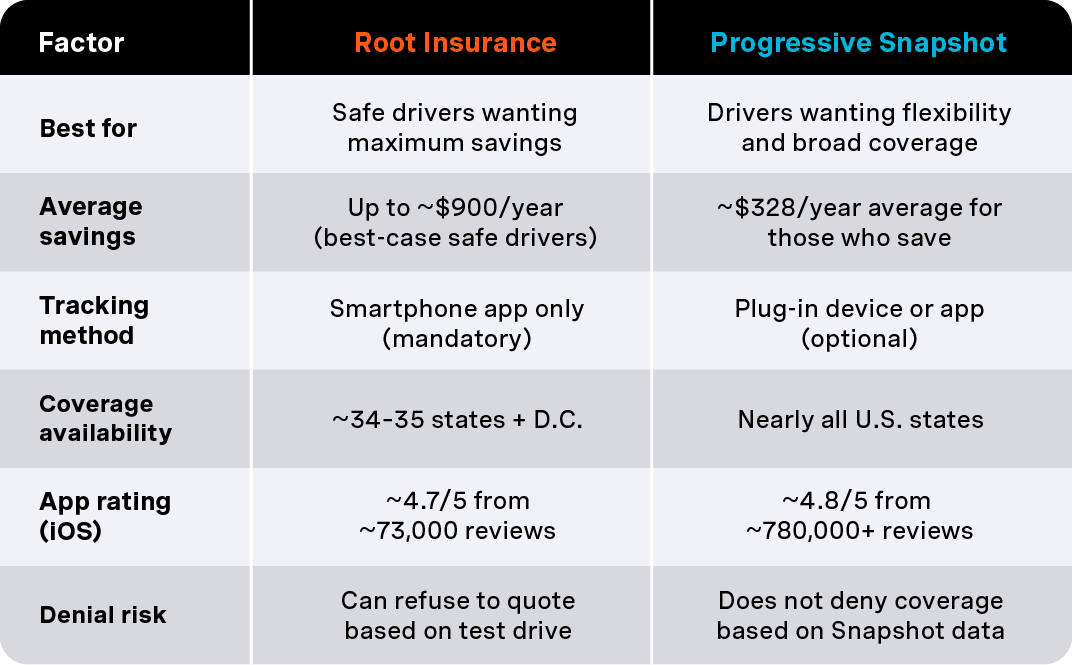
The headline takeaway: Root offers higher ceilings for savings but comes with real eligibility risk, while Progressive delivers reliable, lower-risk discounts with far broader availability.
How your insurer collects and interprets driving data directly determines the accuracy of your rate-and whether you're being rewarded or penalized fairly.
Root's tracking is entirely smartphone-based and mandatory. During the roughly 30-day test drive, the Root app uses your phone's GPS, accelerometer, and gyroscope to monitor hard braking, rapid acceleration, time of day you drive, speed consistency, and trip frequency. Driving behavior is the primary factor in insurance rates at Root-traditional demographic factors are minimized or eliminated. If you don't pass Root's safety threshold, they may refuse to insure you altogether. Once insured, continued good driving can further lower premiums at renewal.
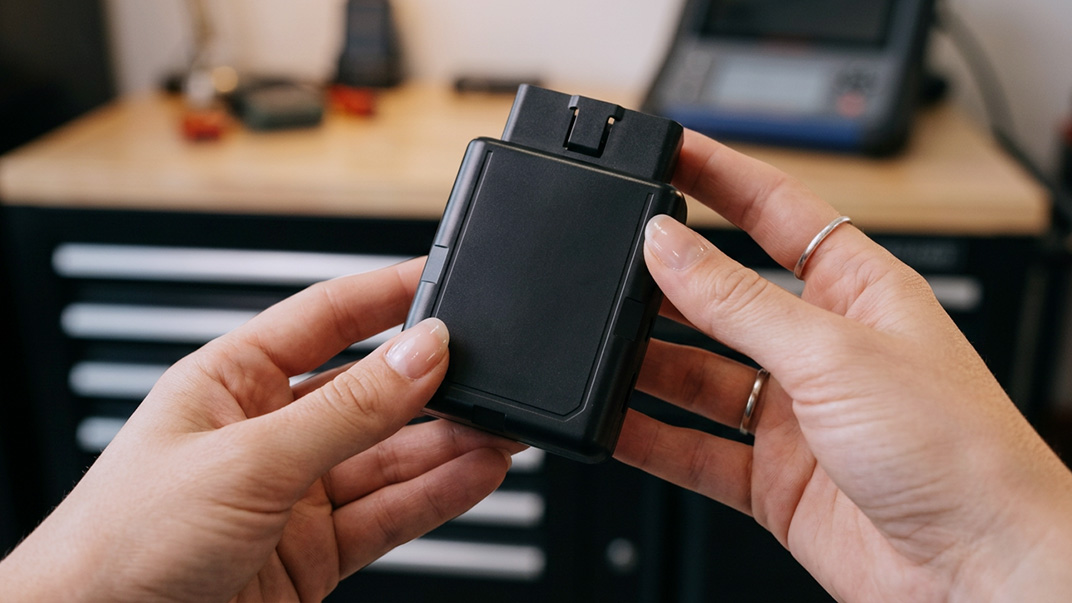
Progressive's Snapshot program tracks similar metrics-hard braking, rapid acceleration, time of day, total mileage-but offers two collection methods. The plug-in OBD-II device connects directly to your vehicle for more precise data capture without relying on phone hardware. The app-based version, available in select states, also monitors phone use behind the wheel. Telematics insurers base premiums on driving habits rather than traditional factors, but Progressive still considers standard rating criteria alongside Snapshot data rather than replacing them entirely.
The accuracy trade-off is real. A plug-in device captures data directly from the car, avoiding issues like GPS drift, phone sensor miscalibration, or battery drain that can affect app-based tracking. Root's app-only model is more convenient-no waiting for a device to arrive-but depends entirely on your phone's hardware quality. If you drive with an older phone or inconsistent battery, Root's data collection could produce inaccurate readings that hurt your rate.
Winner: Progressive Snapshot - The option to choose between a plug-in device and an app gives Progressive an edge in tracking flexibility and potential accuracy. Root's app-only convenience is appealing, but the hardware dependency and mandatory nature of its tracking create more risk for drivers.
Ultimately, what most drivers care about is cost and policy price. Car insurance prices increased by 55 percent since 2020, and 85 percent of drivers worry about affording premiums. Telematics programs allow for lower premiums based on safe driving, making the savings comparison between Root and Progressive critical.
Root claims that safe drivers could save up to about $900/year compared to what they'd pay without a driving-based discount. That figure represents the best-case scenario for the safest drivers-those with minimal hard braking, little night driving, and moderate mileage. Average savings are less precisely published, but Root highlights "hundreds of dollars" in customer testimonials. The catch: if your test drive data doesn't meet Root's threshold, you may get no quote at all, meaning you save nothing and must find cheaper alternatives.
Progressive Snapshot delivers more modest but more predictable results. According to Progressive, drivers who save with Snapshot save an average of about $328/year. Some estimates suggest most customers enjoy around a $130 discount through participation alone, showing how drivers save even before renewal scoring kicks in. Progressive provides an initial participation discount just for enrolling, then adjusts your rate at renewal based on actual data. If your data shows risky patterns, your renewal rate could increase-but Progressive generally does not deny insurance based on Snapshot results.
For context on the broader market: State Farm's telematics program offers up to 30 percent off, GEICO's average rates are over 20% below the national average even without telematics, and State Farm has an average full coverage rate of $2,030 per year. Progressive's rates for drivers with a DUI are 18% lower than average, making it more forgiving for drivers with blemished records. A DUI increases your premium by 94 percent on average across the industry, so Progressive's flexibility matters. Erie's rates for teen drivers are over 30% below the national average, offering another affordable alternative for families.
Mileage-based rates cater to drivers with infrequent usage, and both Root and Progressive reward lower-mileage driving-though Root weights this more heavily in its overall score.
Winner: Root (for the safest drivers) - If you're confident in your driving habits and willing to accept eligibility risk, Root's potential savings are substantially higher. Progressive wins on predictability and accessibility-you won't be denied coverage, and the participation discount provides guaranteed value even before your data is scored.
Since both companies rely on mobile technology for their telematics programs, app quality directly affects your daily experience-from monitoring your driving score to filing a claim.
The Root app carries an iOS rating of approximately 4.7 out of 5 from around 73,000 reviews. Customers praise the clean interface, ease of getting quotes, transparent driving score feedback during the test drive, and simple claims filing. On Android, the rating drops to roughly 3.5 out of 5 with fewer reviews, suggesting platform-dependent quality. Frustration tends to center on being denied a quote after completing the test drive, lack of in-person agent support, and occasional sensor or GPS issues.
The Progressive app rates approximately 4.8 out of 5 on iOS from over 780,000 reviews, with Android ratings around 4.57 from millions of downloads. Users appreciate Snapshot progress tracking within the app, digital ID cards, robust claims tools, and visibility into discounts. Complaints focus on a lack of transparency in how Snapshot scoring works and occasional frustration when the tool penalizes defensive braking. Reputation regarding ease of filing claims varies among insurers, but Progressive's multi-channel approach-app, phone, or local agent-gives it an advantage in claim accessibility.
Both apps drain battery when tracking in the background, and both collect data that raise privacy considerations. Unlike Root's app-only model, Progressive customers who prefer not to run an app constantly can opt for the plug-in device instead.
Winner: Progressive - Sheer volume of positive reviews (780,000+ vs 73,000), higher cross-platform ratings, and multi-channel support give Progressive the edge. Root's app is well-designed for what it does, but the Android experience lags, and the absence of agent or phone-based support is a drawback for customers who want a person to contact when trouble arises.
Having the right coverage in your state-with add-ons that protect your specific needs-is non-negotiable.
Root is available in approximately 34–35 states plus Washington D.C., but remains unavailable in many states including Alaska, Hawaii, New York, New Jersey, Michigan, Idaho, and several New England states. Root offers standard auto coverage-liability (bodily injury and property damage), which is where higher limits can better protect your assets after a serious accident, comprehensive, and collision-and includes roadside assistance in many states (excluding California and Nevada). However, Root does not offer gap insurance, and motorcycle, ATV, and exotic vehicle coverage are excluded. Coverage options may include OEM parts replacement and extensive roadside assistance in supported states. Bundling auto with renters insurance or home insurance is possible in limited states through partners.
Progressive is available in nearly all U.S. states, with Snapshot availability varying by state based on regulatory approval. Progressive offers a full suite of auto insurance services, including liability, comprehensive, collision, rental reimbursement, roadside assistance, and numerous add-ons. Traditional insurers may offer extensive discounts for bundling and loyalty, and Progressive excels here-customers can bundle auto with homeowners coverage, insure multiple vehicles, and access agent support. Progressive covers a wider range of vehicle types and provides more flexible coverage levels.
For the military community, it's worth noting that USAA offers the cheapest rates for military members and veterans, making it a strong alternative if you qualify. Families in Illinois, Wisconsin, California, and other states with specific regulatory requirements should verify availability for both Root and Progressive before committing. Coverage choices should fit not just today's budget but your future needs if you expect your insurance needs to change.
Winner: Progressive - Broader state availability, more coverage types, more add-ons, and the flexibility to purchase bundled financial products make Progressive the clear winner for coverage. Root's limited availability and excluded vehicle types are significant constraints that may lock out many potential customers.
For most drivers, Progressive Snapshot is the stronger all-around choice because it combines meaningful savings with zero risk of denial, wider availability, and more robust coverage options. But for the safest, most disciplined drivers in Root's service area, Root's savings potential is hard to match. The fair comparison isn't about which company is universally better-it's about which model fits your risk tolerance and driving reality.
If neither Root nor Progressive feels right, compare other options: GEICO's average rates are over 20% below the national average without requiring telematics, State Farm's telematics program offers up to 30 percent off with a more traditional insurer experience, and USAA remains the most affordable provider for military members and veterans.
Yes, you can cancel Progressive at any time and apply for Root. Progressive prorates refunds for unused premium. However, Root requires you to complete the approximately 30-day test drive before providing a quote, so plan for a waiting period where you'll want to remain covered under your existing policy until Root confirms eligibility. If Root's test drive doesn't go well and they refuse to quote you, you'd need to find coverage elsewhere-so don't cancel Progressive until you have a Root policy in hand.
It depends on the method. Progressive's plug-in OBD-II device captures data directly from the vehicle's computer, which avoids phone-related issues like GPS drift, sensor miscalibration, and battery drain. This tends to produce more precise data. Root's smartphone-only approach is convenient but relies on your phone's hardware quality. Both collect similar metrics-hard braking, acceleration, time of day, mileage-but the device-based option generally offers higher data fidelity. In states where Progressive offers app-only Snapshot, accuracy trade-offs are similar to Root's.
No, and this is a critical difference. Root may deny you a quote entirely if your test-drive data falls below its safety threshold-you simply won't be offered insurance. After you're insured, worsening driving behavior can lead to significant rate increases at renewal. Progressive takes a more forgiving approach: poor Snapshot data may increase your renewal rate, but Progressive generally does not deny coverage based on Snapshot results. If you opt out of Snapshot early or provide insufficient data, you may lose the participation discount, but you'll still remain covered. Erie's rates for teen drivers are over 30 percent below average, making it another alternative worth exploring for families with younger drivers whose driving data might not yet reflect consistent safe driving habits.
Whether you land on Root or Progressive, there's a step both companies skip over: coming up with the deposit. Most insurers require a lump sum upfront to activate a policy, and that number can run into the hundreds of dollars regardless of how safe a driver you are or how much your Snapshot score or Root test drive saves you long-term.
That's where OCHO comes in. OCHO isn't an insurer and doesn't compete with Root or Progressive on coverage. Instead, OCHO is a licensed broker and premium finance lender that covers your insurance down payment with an interest-free loan, then lets you pay it back on a schedule that matches your payday instead of a due date picked by the insurer. So even a driver who qualifies for Root's best telematics-based rate, or who's counting on Progressive's Snapshot discount to kick in, doesn't have to front the full deposit out of pocket to get covered in the first place.
A few reasons customers choose to finance their deposit through OCHO:
For someone weighing Root against Progressive because the eligibility risk or higher upfront cost feels like a real barrier, OCHO addresses a different part of the problem: not which telematics program scores your driving best, but how to actually afford the deposit for whichever one you pick, without derailing your budget to do it. Apply today, and see how low we can get your down payment.
Compare & get covered fast
Find and compare auto insurance in minutes, and get your free credit score.
Choose when you pay
Select payment dates that line up with your payday.
Manage everything in one place
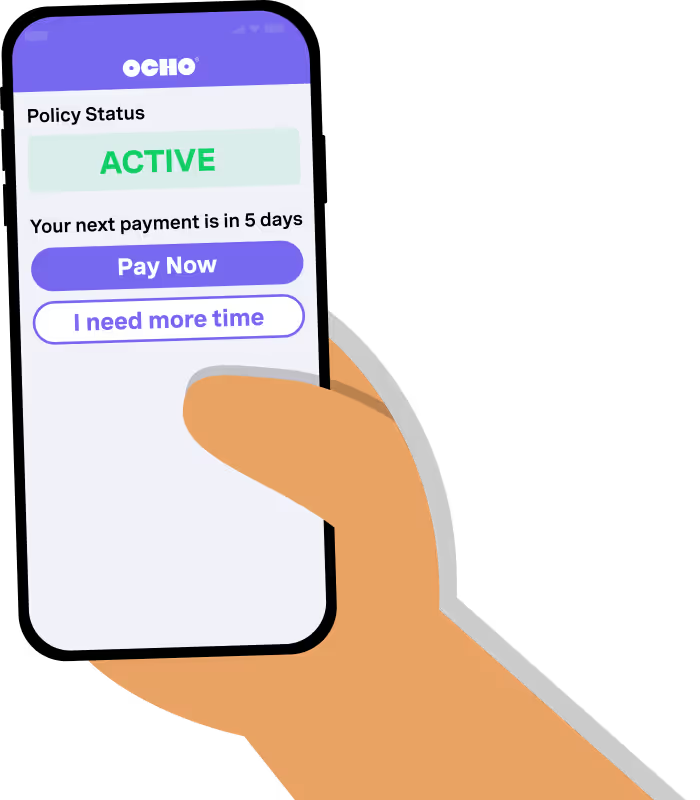
Track your policy, manage payments, and request a payment extension right from your dashboard.




.svg)