
If you drive a car in America, you almost certainly need insurance. But not all auto insurance is created equal, and understanding where you fall in the insurance landscape can save you serious money. Let's break down what standard insurance actually means, what it covers, and how you can qualify.
Standard auto insurance is for average-risk drivers - people with relatively clean driving records, continuous coverage history, and vehicles that don't raise red flags with underwriters. It's the most common type of insurance policy sold in the U.S., and it sits between "preferred" coverage (reserved for the lowest-risk individuals) and "non-standard" or high-risk auto insurance, which is sometimes called the last-resort market.
Most states require drivers to carry auto insurance or prove financial responsibility in some other way. As of 2026, only New Hampshire allows drivers to self-insure as an alternative to purchasing a policy. For everyone else, standard insurance is the most straightforward way to meet those legal requirements and get on the road legally.
Now, you might also hear "Standard Insurance" used as a company name or brand. In this article, we're using "standard insurance" as a general industry term - the category of insurance products designed for typical, everyday drivers who don't fall into high-risk territory.
Here's a quick look at what this page covers and the main questions we'll answer:
Standard auto insurance policies bundle several essential components to cover injuries and property damage. For a deeper dive into common car insurance coverage types and options, remember that the exact coverages, limits, and optional add-ons vary by state and by the insurance company you choose, but the core structure is remarkably consistent across the country.
Standard car insurance usually includes core coverages such as liability and collision, plus several other protections that round out a solid policy. Let's walk through each one.
Liability coverage is required in nearly every state, making it the foundation of any auto insurance policy. It pays for damages or injuries caused to others in an at-fault accident - both bodily injury to people and property damage to their vehicles, structures, or other belongings.
States establish minimum requirements for auto insurance policies, and these minimums differ significantly. For example, some states still use the common 25/50/25 split (that's $25,000 per person for bodily injury, $50,000 per accident, and $25,000 for property damage). But several states have recently raised their minimums: California moved to 30/60/15, New York requires 25/50/50, and New Jersey bumped its limits to 35/70/25 as of January 1, 2026.
Here's the thing: state minimums are just that - minimums. Many drivers choose higher limits like 100/300/100 because if you cause an accident that exceeds your coverage, you're personally on the hook for the rest. That's a risk most people don't want to take.
Collision coverage helps pay to repair or replace your car after an at-fault accident or any crash with another vehicle or object, regardless of who caused it. Collision and comprehensive coverage are typically required by lenders if a vehicle is financed or leased - so if you're making payments on your car, you almost certainly need this.
Deductibles for collision typically range from $250 to $1,000. Choose a higher deductible and your premium drops, but you'll pay more out of pocket when you file a claim. It's a trade-off worth thinking about based on your financial situation.
Comprehensive coverage protects against non-collision damages like theft and vandalism. It also covers fire, hail, flooding, falling objects, and animal impacts - think deer collisions in the Midwest or hailstorms that tear through Texas every spring.
Like collision, comprehensive comes with a deductible you select. One important detail: comprehensive claims generally have a smaller impact on your future rate than collision claims do, since they're typically events outside your control.
Uninsured/underinsured motorist coverage pays for medical expenses and repairs when the at-fault driver lacks insurance or doesn't carry enough to cover your losses. Some states require this coverage; others offer it as optional.
Why does this matter? According to the Insurance Information Institute, roughly 15% to 20% of drivers on U.S. roads are uninsured. And many more are underinsured, carrying only bare-minimum limits that won't come close to covering a serious accident. UM/UIM is strongly recommended, especially in states with high uninsured-driver rates.
Medical Payments or Personal Injury Protection helps cover medical expenses regardless of fault. MedPay is straightforward - it pays medical bills for you and your passengers after an accident, no matter who caused it.
PIP goes further. It can also cover lost wages, funeral costs, and essential services like childcare while you recover. PIP is required in no-fault states like Florida, Michigan, and New York. Keep in mind that Florida's insurance landscape is shifting: HB 1181 eliminated the PIP requirement effective July 1, 2026, replacing it with a bodily injury liability requirement.
Most insurers offer common optional add-ons like roadside assistance and rental reimbursement. Other popular extras include:
For a mid-priced sedan, a standard policy might include:
Nationally, full insurance coverage averages around $2,244 per year, while liability-only policies average roughly $1,176 per year. If you’re wondering how much car insurance should cost for you, remember those numbers vary dramatically by state - in Wyoming, minimum liability runs about $326/year, while in New York it's closer to $2,546/year.
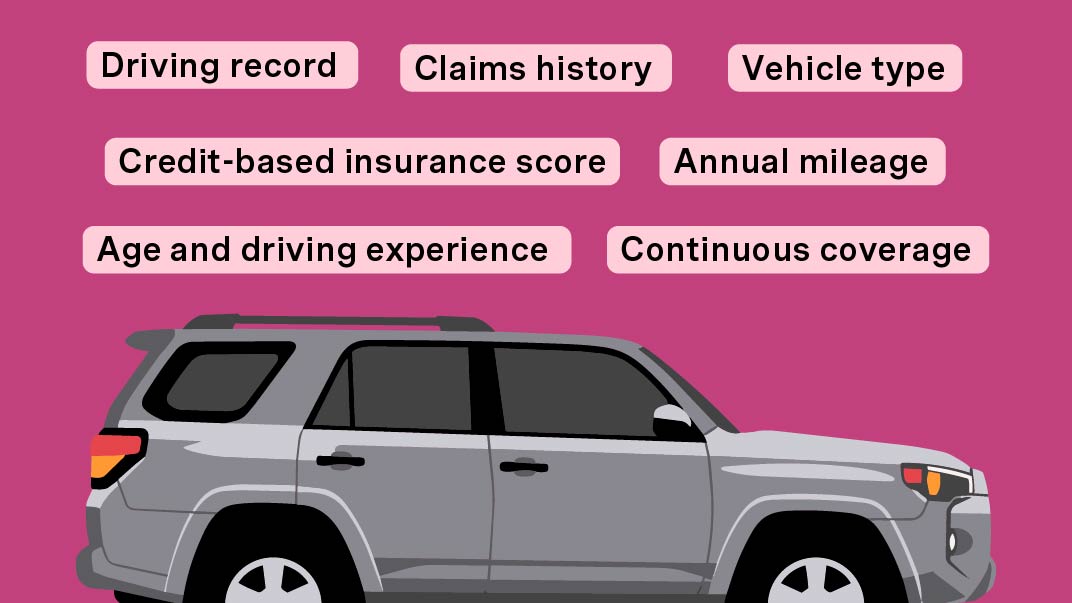
When you apply for standard auto insurance, the company doesn't just hand you a rate. Insurers underwrite your application by assessing a range of risk factors to determine where you land on their pricing spectrum.
Here are the main factors insurers evaluate:
Insurers consider driving history and credit when underwriting because these factors are statistically correlated with the likelihood and cost of future claims. A driver with a clean record and solid credit simply costs the insurance company less, on average, than one without.
Standard insurance is for average-risk drivers with few blemishes. That doesn't mean you need a perfect record. A single minor ticket from a few years ago or one small fender-bender probably won't disqualify you. But repeated at-fault accidents, DUI convictions, or a long lapse in coverage will likely push you into non-standard territory.
Standard auto insurance offers affordable coverage options precisely because the pool of standard drivers represents lower expected risk. That's the deal: you bring a reasonable track record to the table, and the insurer provides you with better rates, more coverage flexibility, and access to discounts.

Let's say you're a 35-year-old driver living in Dallas, Texas. You drive a 2022 Toyota Camry, commute about 12,000 miles per year, and haven't had any accidents or tickets in at least five years. An insurer would likely classify you as a standard - or even preferred - risk.
Your quote might look something like this:
On top of your base rate, you could stack discounts: safe driver, multi-car (if you insure more than one auto), multi-policy (bundling with homeowners insurance, for example), anti-theft device, and possibly a telematics or usage-based discount if you opt in. To be sure you understand exactly how these savings show up in your policy, it helps to know how to read your car insurance policy. Those discounts can knock 15%–30% off your premium.
If you're currently unable to qualify for standard rates, or if you want to make sure you stay in the standard market, here are practical ways to get cheaper car insurance:
Qualification rules vary by company and state, but the general principle holds everywhere: demonstrate that you're a responsible, low-risk driver, and you'll find your way into the standard market.
If you've been stuck in non-standard coverage, don't lose hope. Moving back into the standard tier is often possible after 3–5 years of safe driving, on-time premium payments, and maintaining continuous coverage. If you had an SR-22 insurance filing requirement, completing that submission period without new violations is a critical step. Many insurers periodically review their policyholders' risk profiles, and some will proactively offer you standard rates once your record improves. If yours doesn't, take action: contact multiple insurers and request a fresh quote every 6–12 months.
Standard auto insurance is designed for average-risk drivers, while non-standard insurance exists for higher-risk situations - multiple serious violations, prior policy cancellations, DUI convictions, or specialty vehicles that standard carriers won't touch. Both serve a purpose, but the differences in cost, coverage, and flexibility are significant.
Non-standard policies cover high-risk drivers with poor records. If you fall into that category, a dedicated resource on non-standard auto insurance for high-risk drivers can help you understand what to expect. Around 40% of new policies are non-standard insurance policies, which tells you just how many individuals fall outside the "average risk" category for one reason or another.
Here's what you can typically expect from a non-standard policy:
Drivers with low credit may qualify for non-standard insurance even without a terrible driving record, since some states allow insurers to use credit-based scores in their rating models.
Some major insurance carriers operate both standard and non-standard divisions under different brand names. Others specialize in one segment. Companies like Dairyland and The General focus almost exclusively on non-standard auto insurance, while mainstream carriers handle the standard market with broader insurance products, more digital tools, and more robust customer support.
Sometimes non-standard coverage is your only option - and that's okay. If you've recently had a DUI conviction, racked up multiple at-fault accidents, or let your policy lapse for an extended period, standard insurers will likely turn you down. Non-standard insurance exists to keep you legal and on the road while you work on improving your profile.
Think of it as temporary. Life happens, records get messy, but the situation doesn't have to be permanent.
Here's how to make the move over time:
When doing a comparison of car insurance quotes, make sure to include coverage limits and optional benefits alongside price. Here are the key practical differences at a glance:
Whenever possible, aim for standard insurance. It provides more affordable, more flexible, and more stable car insurance coverage for the long term. If you have questions about where you stand, the best step you can take right now is to review your driving record, check your credit, and get quotes from multiple providers. You might be closer to standard rates than you think.
Comparison of car insurance should include coverage limits and optional benefits - don't just click on the cheapest quote without understanding what you're actually getting. Take the time to find the right balance of price, coverage, and peace of mind. Your future self will thank you.
Compare & get covered fast
Find and compare auto insurance in minutes, and get your free credit score.
Choose when you pay
Select payment dates that line up with your payday.
Manage everything in one place
Track your policy, manage payments, and request a payment extension right from your dashboard.





.svg)