"Prepaid car insurance" sounds straightforward - you pay for coverage in advance, use it, and you're done. No monthly bills, no surprises. In reality, though, most U.S. auto insurers don't sell coverage the way you purchase a prepaid phone card. Instead, they price policies in 6-month or 12-month terms, and you either pay the full cost up front or spread it across installments.
So why do so many drivers search for prepaid car insurance? Usually, it comes down to one of three things. First, they want strict budget control - one payment, no recurring withdrawals to worry about. Second, they're renting a car from a rental company and are used to paying for insurance-like add-ons daily before they even leave the lot. Third - and this is a big one - they've had trouble qualifying for traditional policies or financing, and "prepaid" feels like a way around the credit check and deposit headaches.
Here's the truth as of 2026: true prepaid auto insurance, where you load up a block of miles or days and use them down, is extremely rare for personal cars in the U.S. What you'll actually find are similar-sounding models - pay-as-you-go, pay-per-mile, or just paying your standard policy in full up front. Each one works differently and fits different people.
At OCHO, we take a different approach entirely. Instead of asking you to prepay a large lump sum, we help you split the required down payment on a standard policy into smaller, interest-free installments that match your pay cycle. No prepaid blocks. No mystery.
Here's what this article covers:
Not all "prepaid" models are created equal. Before you purchase anything, it helps to understand the three main categories: fully prepaid term policies, true "top-up" prepaid models, and usage-based pay-per-mile insurance. They overlap in some ways, but the mechanics - and what you actually pay - are quite different.
This is the most common version. Paying the entire 6-month policy up front to insurers like Progressive or State Farm technically functions as "prepaid" coverage. You buy a policy covering, say, January 1, 2026 to June 30, 2026, hand over the full premium at the start, and you're covered for the term.
The policy still has a fixed start and end date, and cancelling early can trigger partial refunds and possible fees. If your premium is $1,200 for six months and you cancel in month three, you'll typically get a prorated refund - but the insurer may claw back any paid-in-full discount you received and charge a cancellation fee on top.
If you don't pay in full, the alternative is installments - usually monthly. Most insurers tack on installment fees of 3–10 per payment, which adds 36–120 a year to your cost. It's not a huge number on its own, but for a family already stretching every dollar, it matters.
This is the model people usually picture when they hear "prepaid car insurance." A customer loads a dollar amount or a block of days or miles into an account and coverage remains active until used up. Once your block runs out, you top up again - like a prepaid phone.
This is niche. Very niche. Only a handful of newer insurtechs or app-based services have attempted it, and it may not be available in every state. Regulatory and actuarial challenges make this model difficult to scale. California explored mileage-block regulation back in 2009, but widespread adoption never followed. If you find a true top-up prepaid program in your state, read the fine print carefully - coverage gaps between top-ups can leave you uninsured and in legal trouble.
When most people search for prepaid car insurance, this is often what they actually mean. Pay-per-mile insurance uses a base rate plus a per-mile charge, billed monthly based on actual driving. If you drove 300 miles in a month with a $48 base and $0.08/mile rate, your bill that month would be about $72. OCHO also offers its own pay-as-you-go car insurance designed for drivers who need predictable, flexible payments without invasive tracking.
Companies like Metromile operate this model in states including California, Oregon, Illinois, and Washington. Nationwide's SmartMiles program is another usage-based option geared toward low-mileage drivers. Telematics devices or smartphone apps track your odometer readings or driving behavior to calculate the variable portion.
These are not strictly prepaid - you're billed after the fact based on usage. But for low-mileage drivers, they can be significantly cheaper than a traditional flat-rate policy.
When renting for a week in 2026 from companies like Enterprise or Hertz, drivers can prepay a fixed daily fee for insurance-like protection products - Loss Damage Waiver (LDW), supplemental liability, or personal accident coverage - instead of relying on their own auto policy. You pay up front for the rental period, and coverage ends when you return the keys.
These rental add-ons are not a replacement for ongoing personal car insurance. They cover only the rental vehicle during that specific trip, can be expensive on a per-day basis, and do nothing for your driving record, credit history, or continuous coverage requirements.
Prepaying your car insurance can be smart for some drivers but risky for others - especially if you're living paycheck to paycheck or your car situation might change mid-term. Before you commit, it can help to review proven ways to get cheap car insurance so you understand all your savings options. Here's a clear breakdown so you can decide whether it's the right move for your month-to-month reality.

Here's the meta point most "prepaid car insurance" articles miss: the reason people search for prepaid options isn't because they love paying everything up front. It's because they want predictable, manageable costs and the peace of mind that comes with knowing they're covered. They want to stay insured without the stress of a surprise bill blowing up their budget.
That's exactly the problem OCHO was built to solve - without requiring a huge lump sum or a rare prepaid product that barely exists in the market. If you want to know more about the mission behind this approach, you can read about OCHO as a company focused on fairness and access.
OCHO is a B2C online car insurance agency and licensed finance company where you can get easy, free car insurance quotes. We do two things at once:
Our focus is on underserved and working-class drivers - the people traditional insurers punish with inflated deposits and rigid billing schedules. If you're curious about the specifics of our tools and process, the How OCHO works FAQ walks through pricing, down payments, and our support options.
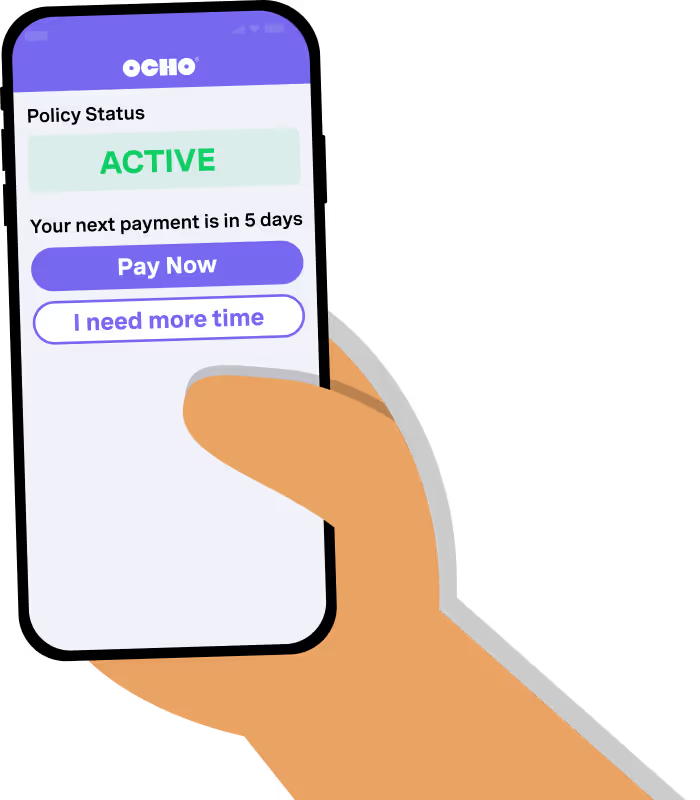
Instead of paying a 400–600 down payment on a standard 6-month policy all at once, OCHO can split that amount into smaller installments that align with your pay cycle - weekly, bi-weekly, or twice a month. You set the schedule that matches your paydays.
No added interest. No late fees within OCHO's grace structure. Contrast this with traditional premium finance contracts that often charge both fees and interest, or credit cards with outrageous rates that make your insurance cost balloon over time.
In some states (Arizona, Georgia, Texas, and Washington), OCHO can even pay the full premium to the carrier on your behalf - qualifying you for the carrier's paid-in-full discount - while you repay OCHO in installments. You get the discount of prepaid and the flexibility of a payment plan. That's a combination no true prepaid product can match. You can check which states OCHO serves and how coverage works by location before you apply.
The rideshare driver: Your income fluctuates by week based on how many rides you complete. A rigid monthly bill that hits on the 15th regardless of whether that's a good week or a terrible one? That doesn't work. With OCHO, your payment dates sync to your Uber or Lyft payout schedule, so you pay when money is actually in your account.
The family in transition: You're switching cars, moving to a new city for a job, or returning a leased vehicle to a dealership in mid-2026. You need coverage that starts immediately and doesn't require you to commit a massive lump sum for a full term you might not complete. OCHO's flexible financing lets you get covered now and adjust later.
The budget-stretched parent: You've got children, rent, and a grocery bill that grows every month. Dropping $800 on car insurance today means something else doesn't get paid. OCHO breaks that $800 into pieces small enough that you can handle it alongside everything else - without interest eating into your family's budget, using the same no-deposit car insurance approach we offer to eliminate large upfront payments.
The process takes minutes:
You can also use the car insurance calculator to estimate how much coverage you should carry before you start shopping, and see examples from real customer reviews of OCHO to understand how the experience has worked for drivers like you.
Even when you're renting, having a continuous personal policy arranged through OCHO often costs less over a year than repeatedly buying high daily insurance fees from a rental company. If you rent cars more than a couple of times a year, compare the rental counter's daily add-on cost to a 6-month policy financed through OCHO. The math usually isn't close.
For most budget-conscious drivers, flexible payment plans paired with strong coverage are safer and more practical than trying to hunt down rare true "prepaid" auto products. The goal was never really to prepay - it was to feel in control of your money while staying covered. That's what OCHO delivers.
If you want more comments, opinions, or details on how this all works, don't just take our word for it. Comment, share this post with someone who's been struggling to afford coverage, and see for yourself what's possible when an insurance company actually takes your side.
Ready to stop stressing about your car insurance payment? Get a quote from OCHO today and see how much you could save with $0 down and interest-free payments matched to your paycheck.
Compare & get covered fast
Find and compare auto insurance in minutes, and get your free credit score.
Choose when you pay
Select payment dates that line up with your payday.
Manage everything in one place
Track your policy, manage payments, and request a payment extension right from your dashboard.