Arizona doesn't mess around when it comes to car insurance. If you drive on Arizona roads, you need coverage - and the state has real teeth behind its enforcement. Here's everything you need to know about AZAZ car insurance requirements heading into the second half of 2026.
Arizona operates under an at-fault insurance system, meaning drivers must carry proof of financial responsibility to legally operate a motor vehicle. Auto insurance has been mandatory in Arizona since 1986, and the state hasn't loosened up since.
Because Arizona is not a no fault state, the at fault driver is financially responsible for bodily injury and property damage caused in a crash. Drivers must file claims through the at-fault driver's insurance company to recover losses. Arizona follows pure comparative negligence under A.R.S. § 12-2505, which means compensation is reduced by each party's percentage of fault - even if one driver is 90%+ at fault.
All arizona drivers must carry proof of insurance in the vehicle at all times and present it during traffic stops and after a car accident. Continuous coverage is required for vehicles with active arizona registration, and lapses trigger electronic non renewals reports to the Arizona MVD.
As of July 2026, A.R.S. § 28-4009 sets the floor for liability insurance in Arizona. These are the minimum car insurance requirements every driver must meet:
In plain language: if you cause a crash that injures two people and damages their car, your insurance policy would pay up to $25,000 per injured person (capped at $50,000 total) plus up to $15,000 for vehicle repairs and damage to else's property.
These liability minimums apply to most registered vehicles in Arizona, including cars, trucks, motorcycles, and even golf carts driven on public roads. But these are legal minimums - not recommended amounts. A serious collision can easily generate medical bills that blow past $50,000.
Liability insurance exists to protect other people when you're at fault. It does not cover your own injuries or vehicle damage - that's a critical distinction many drivers miss.
Bodily injury liability coverage pays for other people's medical expenses, lost wages, and related costs when you cause a crash. It may also cover your legal defense if the other driver sues you. Property damage liability pays to repair or replace the other driver's vehicle and damaged property such as fences, buildings, or traffic signs.
Liability insurance does not cover your own injuries or vehicle damage. If you cause a wreck and your car is totaled, that cost comes out of your pocket unless you carry additional auto insurance coverage. Many experts recommend coverage limits of 100/300/50 or higher, especially if you have a home or savings to protect from lawsuits.
Arizona law only mandates liability coverage, but most drivers add optional coverage for better financial security. What many drivers call "full coverage" typically means a policy bundling liability, collision coverage, and comprehensive coverage.
Common optional coverages include:
These protections matter most for newer vehicles, financed vehicles, and drivers who can't absorb a major repair bill. Lenders typically require collision and comprehensive on vehicles with loans or leases until the balance is paid off.
Collision coverage is optional coverage under arizona law but is a core piece of most "full coverage" policies. It pays for damages to your vehicle after an accident - whether you hit another car, a guardrail, or a pole - regardless of who was at fault.
Deductibles typically range from $500 to $1,000. A higher deductible lowers your premium but increases out-of-pocket cost after a car accident. Example: a Phoenix driver rear-ends someone in rush-hour traffic. Their liability coverage pays for the other driver's vehicle repairs, but collision coverage handles fixing their own car minus the deductible.
Comprehensive coverage protects against non-collision damages, and Arizona's climate makes it especially relevant. Common claims include theft, vandalism, wildfire damage, monsoon-related flooding, hail, falling objects, and animal collisions on rural roads.
Comprehensive coverage protects against non-collision damages like theft with its own deductible separate from collision. Some insurers in Arizona offer no-deductible safety glass options, allowing you to replace safety glass or repair a cracked windshield with no out-of-pocket cost. If you've ever caught a rock off a dump truck on I-17, you know how valuable that is.
Uninsured/underinsured motorist coverage is optional in Arizona, but insurers must offer it with every auto insurance policy. You can reject it in writing - but think twice before you do.
Uninsured motorist coverage pays for your and your passengers' injuries if you're hit by a driver with no insurance or involved in a hit and run accident. Underinsured motorist coverage helps when the at-fault driver's liability limits are too low to cover all of your medical expenses. With roughly 1 in 8 Arizona drivers uninsured, UM/UIM is especially valuable in metro areas like Phoenix and Tucson, where real-world crashes, hit-and-runs, and other life examples of why car insurance is important show how quickly costs add up without protection.
Quick example: an at fault driver carries only $25,000 bodily injury, but your medical bills hit $60,000. UIM coverage can fill that $35,000 gap. The 2026 Arizona Supreme Court ruling in State Farm v. Balzan also clarified that drivers may stack UIM coverage across multiple household policies unless the policy language explicitly prohibits it.
Medical payments coverage and other add-ons provide extra protection regardless of fault. MedPay pays medical expenses for you and your passengers after a crash, typically in limits from $1,000 to $10,000. Since Arizona does not require personal injury protection like some no-fault states, MedPay helps fill that gap - particularly if your health insurance is limited.
Other helpful add-ons include rental car reimbursement, roadside assistance (a lifesaver on long rural stretches between Phoenix and Flagstaff), and custom equipment coverage. Review your health insurance and emergency savings when deciding how much you need.
Arizona enforces its car insurance requirements through escalating fines, suspensions, and SR-22 filings. Failure to meet insurance requirements can lead to penalties that get worse fast. Here's the penalty structure:
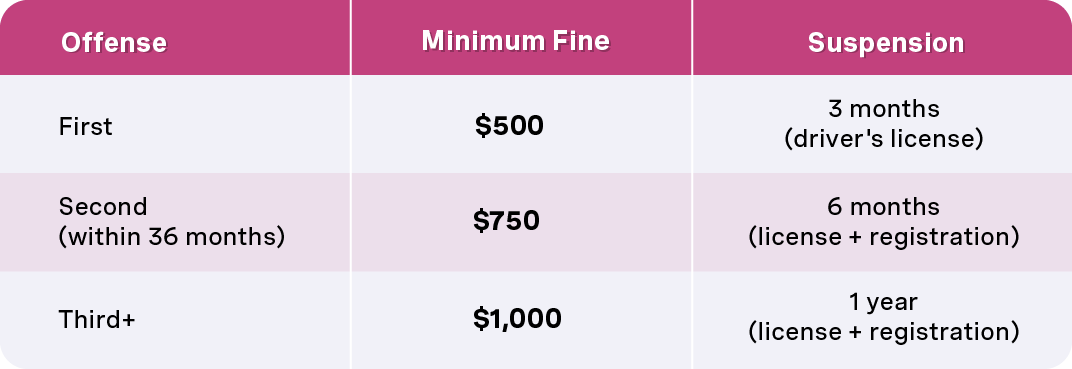
Penalties escalate with each violation of no insurance. Reinstating your license requires paying fines and obtaining SR-22 insurance. The Arizona MVD can suspend vehicle registration automatically if your insurer reports a lapse - no traffic stop required.
Failure to maintain insurance can result in vehicle registration issues even if the car is parked.
If you plan not to drive a vehicle, explore cancelling registration or obtaining a De-Insured Certificate through the arizona department of transportation rather than letting your policy lapse and trigger hidden costs.
Arizona follows a pure comparative negligence system under arizona law, which means you can recover damages even if 99% at fault - your recovery is simply reduced by your fault percentage.
Fault is determined using evidence by police and insurance companies: crash reports, witness statements, photos, and accident reconstructions. Example: a driver found 30% at fault in a $10,000 claim recovers $7,000. A person 80% at fault could still recover 20%.
Recorded statements and social media posts can affect how insurers assign fault. If fault is disputed or injuries are significant in your accident, consider speaking with a qualified Arizona attorney.
Arizona law allows alternatives to traditional auto insurance, but they're designed for business and fleet operators. Options include surety bonds filed with the state, cash deposits with the Arizona State Treasurer, and certificates of self-insurance for qualified fleets.
These require large financial commitments and state approval, making them impractical for most private drivers. Any alternative must meet or exceed the minimum liability car insurance requirements. Consult the arizona department of Transportation or the Arizona Department of Insurance before pursuing these routes.
Recently moved to Arizona or splitting time between states? New residents usually must obtain arizona car insurance and register their vehicle within about 15 days of establishing residency. Out-of-state policies generally don't satisfy Arizona's financial responsibility laws for vehicles registered here.
Snowbirds who keep vehicles in Arizona must still carry Arizona-compliant insurance on those vehicles while registered. Compare quotes from multiple insurers familiar with Arizona-specific risks like monsoon storms, hail, and high theft rates in certain metro areas, including options for fast, affordable Arizona car insurance quotes.
Meeting state minimums is the starting line, not the finish. Evaluate your driving record, vehicle value, commute, and assets you need to protect. For families, teen drivers, young drivers, and high-mileage commuters, consider higher liability limits plus collision, comprehensive, UM/UIM, and MedPay.
Compare quotes from multiple insurers - look at coverage limits, deductibles, discounts, and claim satisfaction, not just cost. A complete guide to getting free auto insurance quotes can help you shop smart instead of chasing the lowest number. Review your policy at least once a year or after major life changes like buying a car, moving, or adding a teen driver.
These arizona auto insurance faqs cover practical concerns not fully addressed above. For broader questions about coverage types, rental cars, and billing, you can also review car insurance coverage FAQs. Laws and products change, so verify details with your insurer or the Arizona Department of Insurance.
Arizona law requires auto insurance coverage before you drive a newly purchased vehicle on public roads. Some insurers offer a brief internal grace period (7–30 days) to add a new car, but this depends on your insurance policy language, not state law. Contact your insurer before taking delivery - don't assume you're covered. Always confirm any "automatic coverage" provisions in writing. Many drivers get caught assuming the security service or gov performing security verification at registration will sort it out - it won't.
Acceptable proof includes a paper insurance ID card, a digital card on a smartphone app, or a PDF showing your policy number, effective dates, and vehicle information. Arizona allows electronic proof during traffic stops. The insurance must come from a company licensed to do business in Arizona. Officers also run security verification electronically through insurer reports, so verification successful on their end still matters - falsifying proof leads to serious penalties and a respond ray id won't save you from malicious bots of legal trouble.
Yes, rates vary significantly by ZIP code. Higher premiums are common in high-traffic areas like Phoenix, Glendale, and Tucson due to population density, accident frequency, and vehicle theft rates. Rural areas may see lower rates but still face weather and wildlife collision risks. Always compare quotes after moving to a new Arizona city.
Teen drivers (ages 16–19) are statistically higher risk, so adding them often increases premiums substantially. Arizona's graduated licensing system requires teen drivers to be covered by a liability policy once licensed. Ask about good-student discounts, driver education discounts, and usage-based programs. Review your coverage limits when an inexperienced driver joins the policy - the risk of a serious crash rises, and you want enough insurance coverage to cover the injured and protect your family financially.
If your vehicle remains registered, you must generally maintain continuous liability coverage or risk license suspension and fines. Owners storing a car long-term can cancel registration or request a De-Insured Certificate through the Arizona MVD. Comprehensive-only "storage" policies may protect against theft or fire without liability. Talk to both your insurer and MVD before dropping coverage to understand the consequences.
Compare & get covered fast
Find and compare auto insurance in minutes, and get your free credit score.
Choose when you pay
Select payment dates that line up with your payday.
Manage everything in one place
Track your policy, manage payments, and request a payment extension right from your dashboard.




.svg)