
If you've been shopping for auto insurance and seen "250/500" on a quote, you might wonder what those numbers actually mean for your wallet-and your protection. Let's break it down without the jargon.
Liability coverage is written as three numbers-like 25/50/25, 100/300/100, or 250/500/100. Each number is a coverage limit in thousands of dollars.
Example: You run a red light and hit a car carrying three people. Person A has $200,000 in injuries. Person B: $150,000. Person C: $220,000. Total: $570,000. Each person is under the $250,000 per person cap, so no individual claim is cut. But the per accident limit of $500,000 means your insurer pays $500,000 max. The remaining $70,000? That's on you. That's how split limits work in a serious accident.
Here's how the most common bodily injury liability limits stack up:
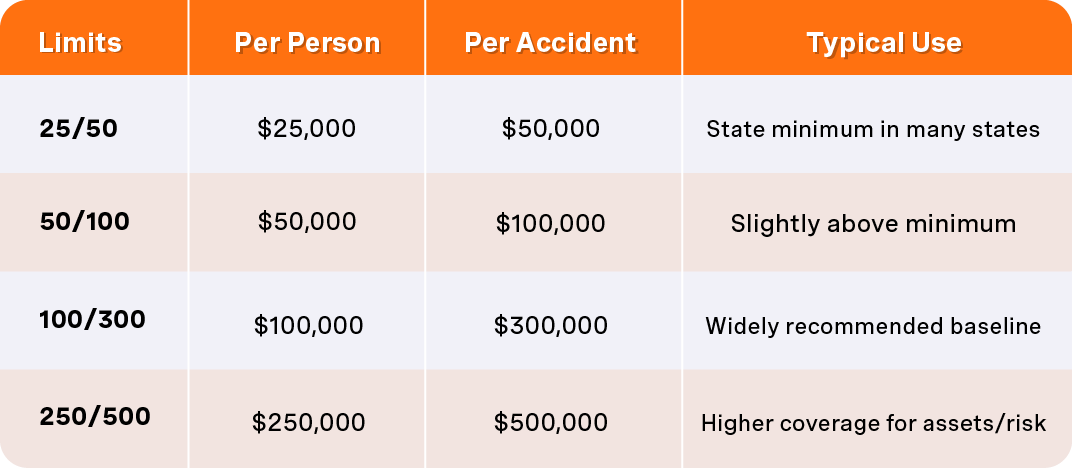
Alabama's minimum liability limits are 25/50/25-and most states hover in a similar range. These limits exist for legal compliance, not real-world protection. If accident costs from a serious crash hit $200,000, a 25/50 policy leaves you covering $150,000+ out of pocket.
At 100/300, most drivers get enough coverage for moderate crashes. But a multi-vehicle pileup or a crash with severe injuries can still produce damages that exceed those policy limits. Real-world crashes, natural disasters, and hit-and-runs show how adequate car insurance coverage protects you from major financial loss. That's where 250/500 shines: it can fully cover scenarios that would bankrupt someone carrying lower limits.
Several states recently raised their minimums-New Jersey moved to 35/70/25 in 2026, California to 30/60/15-but even updated minimums fall short of what a single car accident with hospitalizations can cost, especially for low-income drivers trying to balance affordability and adequate coverage.
Bodily injury liability coverage pays for harm you cause to other people when you're the at fault driver. It does not pay for your own injuries or your own vehicle.
Specifically, it covers:
Coverage triggers when you, or someone listed on your auto policy (like a household member), are found at fault. Bodily injury liability covers medical expenses for others injured in accidents-whether those injuries are minor whiplash or catastrophic, including situations where you're borrowing or lending someone else's car and need to know whose insurance applies. The higher limits you carry, the less likely you'll be writing checks from your own savings after a crash.

High bodily injury limits are critical, but they don't equal enough insurance on their own.
The takeaway: liability coverage limits are crucial for financial protection in accidents, but insurance coverage needs to be layered-liability, collision, comprehensive coverage for theft and non-collision damage, and more.
The right amount of liability coverage depends on your financial situation, not just what your state requires.
250/500 makes sense if you:
Rule of thumb: If your total assets (home equity, retirement, savings) exceed $150,000–$250,000, stepping up from 100/300 to 250/500 is smart. Higher limits like 250/500 protect significant assets from lawsuits, and 250/500 limits are recommended for higher-asset households. Even if you're a renter with fewer assets, future wages can be garnished-higher liability limits safeguard your assets from lawsuits and protect your financial future.
Choosing how much liability coverage you need is a balancing act between what you can afford in premium and what a serious accident could cost you, so it helps to understand how much car insurance should cost for your situation.
A simple process:
Most drivers should aim for at least 100/300. If you have moderate to high assets-or you simply want as much liability coverage as you can afford-move to 250/500. The premium bump is usually far less than people expect.
Review your limits every 12–24 months, or after buying a home, adding a teen driver, or any major life change. Learning how to read your car insurance policy and its fine print makes these check-ins much easier. Your insurance coverage should keep pace with your financial situation.
Bodily injury liability is only one piece of the best coverage. Understanding how all your car insurance coverages fit together is key. Your property damage, collision coverage, and uninsured motorist coverage should be aligned with your liability limits.
Ask your insurer for quotes bundling 250/500 bodily injury, strong property damage limits, matching UM/UIM, and appropriate deductibles, and consider when it might be smarter to pay out of pocket instead of filing a claim to protect your long-term premiums.

Here are answers to common questions about 250/500 that go beyond what we covered above.
No. 250/500 only describes your bodily injury liability coverage limits. "Full coverage" is informal shorthand usually meaning liability plus collision coverage, comprehensive coverage, UM/UIM, and medical coverage. Check your declarations page to see every coverage type and limit-not just the 250/500 figures.
Drivers with few assets may prioritize reaching 100/300 first, but future wages can be targeted in serious liability claims. Compare quotes for 100/300 vs. 250/500-the price difference is often small, and the higher coverage gives real protection even for renters or younger drivers.
No. Your liability coverage pays when you are at fault. In a not-at-fault accident, the at fault driver's bodily injury liability insurance should pay for your injuries. If their limits are too low, your UM/UIM coverage may apply. Carry UM/UIM limits that match your liability limits whenever possible.
Yes-most insurers allow different BI and PD limits (like 250/500/50 or 250/500/100). But an unbalanced policy with high bodily injury and low property damage can leave big gaps if you total an expensive vehicle. Pair 250/500 with a property damage limit that can cover modern vehicle values and multi-car losses.
It varies by insurer, ZIP code, and driving history, but many drivers find the jump from 100/300 to 250/500 adds only a modest amount to their annual premium-sometimes less than $100–$200 per year. For the level of much liability coverage and peace of mind it provides, it's often one of the best-value upgrades on your policy.
Compare & get covered fast
Find and compare auto insurance in minutes, and get your free credit score.
Choose when you pay
Select payment dates that line up with your payday.
Manage everything in one place
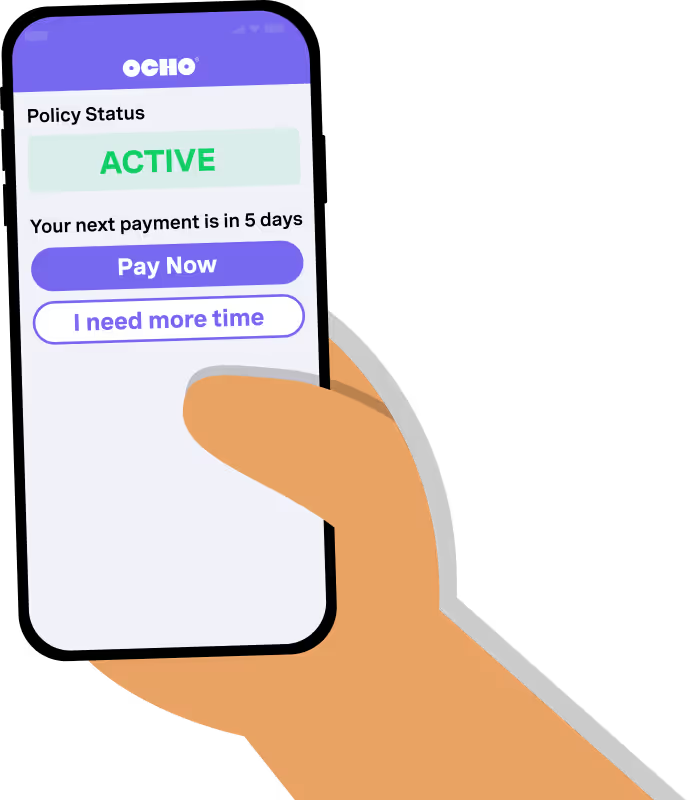
Track your policy, manage payments, and request a payment extension right from your dashboard.




.svg)